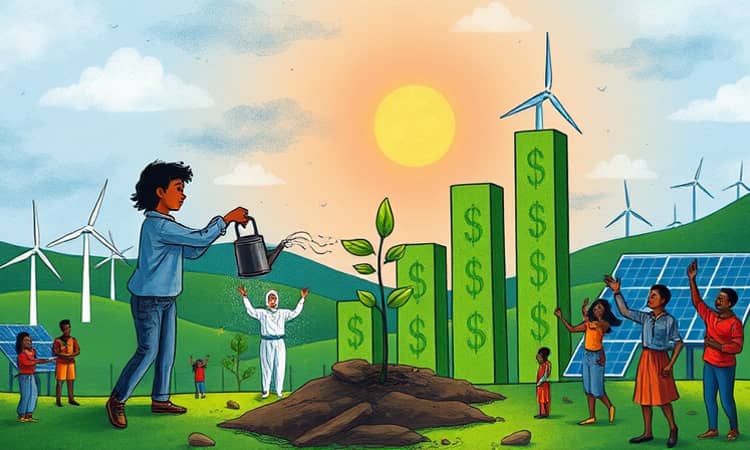
Amid political volatility and shifting global priorities, investors are reimagining how to grow capital while nurturing communities and natural systems. Sustainable investing has reached an inflection point, balancing profits with purpose to create lasting impact.
Introduction to Balanced Investing
The concept of wealth with wholeness merges financial objectives with ecological and social stewardship. This wealth with wholeness approach bridging finance and purpose underpins a movement toward integrating returns with responsibility.
By embedding ESG factors across portfolios—covering environmental, social, and governance criteria—investors access a framework that aligns capital with planetary and human needs. In the US, stewardship policies now cover stewardship anchoring 69% AUM coverage, illustrating a deepening commitment to long-term value creation even amid uncertainty.
Market Resilience in 2025
Despite regulatory challenges such as IRA amendments, state-level restrictions, and scrutiny from proxy advisors, sustainable asset growth remains robust. US sustainable assets climbed to $6.6 trillion in 2025, up from $6.5 trillion the prior year, representing 11% of the $61.7 trillion US market.
Overall market expansion outpaced sustainability growth, slightly reducing market share, yet investors demonstrate unwavering resolve. This resilient growth amid political headwinds underscores the belief that profit and purpose can coexist and flourish.
Performance Edge
Sustainable funds outpaced traditional benchmarks across key metrics. In H1 2025, they delivered a median return of 12.5% in H1 2025, compared to 9.2% for legacy funds. This marks the strongest relative performance since consistent tracking began in 2019.
Private low-carbon solutions achieved 123% cumulative five-year returns, more than doubling the 57% gain of public markets. Such success is attributed to financial materiality and proven track records in sectors like renewable energy, green infrastructure, and sustainable agriculture.
Investor Trends and Strategies
Surveys reveal a powerful consensus: stakeholders are ramping up their sustainable exposures. Key highlights include:
- 86% of asset owners expect a higher proportion of sustainable AUM within two years.
- 79% of asset managers plan to increase ESG allocations in upcoming cycles.
- Regional optimism: over 90% of North American, 82% of European, and 85% of APAC investors are positioned for growth.
Common strategies involve ESG integration in 77% of portfolios, negative screenings for industries such as tobacco and controversial weapons, and thematic investments tied to the UN Sustainable Development Goals, used by half of all managers.
Challenges and Headwinds
While momentum builds, significant obstacles persist. Investors frequently cite:
- Data availability and consistency issues (47%).
- Regulatory fluctuations and policy shifts (43%).
- Political uncertainty impacting long-term planning (37%).
- Scarcity of tailored ESG solutions for 30% of investors.
Only 53% of respondents foresee moderate or strong growth over the next year, down from 73% in 2024. data gaps and evolving regulations temper some optimism and highlight the need for standardized reporting frameworks.
Emerging Opportunities for Wholeness
Innovation at the intersection of finance and sustainability is unlocking new frontiers. Nature-positive transitions unlocking $10 trillion value have become a rallying cry, emphasizing the economic potential of biodiversity, water security, and soil health initiatives.
Climate resilience plays a key role, with renewable energy deployment, adaptation infrastructure, and sustainable agriculture projects drawing record capital. Private finance for nature surpassed $100 billion in 2024—an elevenfold increase since 2020—yet remains a fraction of the $2.7 trillion needed annually to realize nature-positive goals.
Investors increasingly explore regenerative agriculture, clean infrastructure, and impact-driven private markets, aiming to marry strong financial returns with tangible environmental and social benefits.
Consumer and Institutional Shifts
Public and private sectors alike are responding to amplified calls for accountability. A remarkable 83% of consumers now expect companies to advance ESG practices, shaping corporate strategies across industries.
Within finance, 89% of investors consider ESG factors in their decisions, and 90% of asset owners view strong sustainability credentials as a key differentiator when choosing managers. Despite this, only 18% of European firms achieve their desired level of standardized reporting, even though 72% advocate for harmonized disclosures.
Future Outlook and Conclusion
The outlook for sustainable investing is bright. Sustainable debt issuance topped $1 trillion in 2024 for the fifth consecutive year, and ESG-mandated assets are on track to reach $35 trillion by the end of 2025—accounting for half of all professionally managed investments.
As these vehicles exceed 20% of global AUM by 2026, the case for a balanced blend of profit and purpose grows ever stronger. Integrating sustainability at the core of strategy is no longer optional but imperative for capturing the full spectrum of risks and opportunities.
Investors committed to this path will not only secure competitive returns but also contribute to a more resilient, equitable world. By championing better data, policy advocacy, and cross-sector collaboration, stakeholders can seize the vast potential of sustainable finance—driving both economic prosperity and holistic well-being for generations to come.