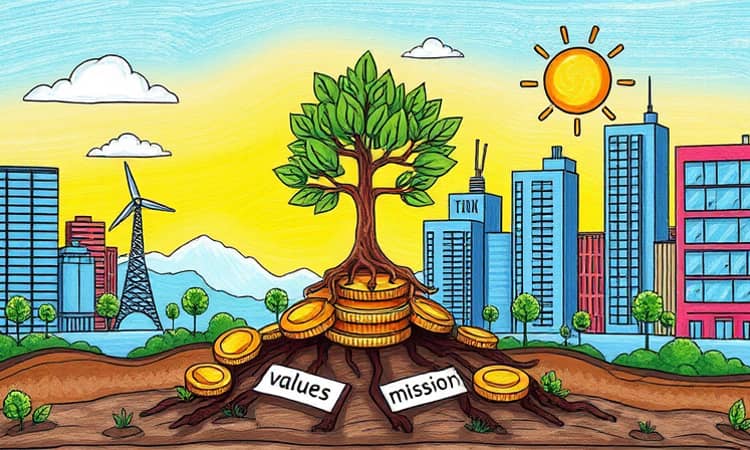
In today's rapidly evolving world, the intersection of entrepreneurship, capital markets, and personal values is creating a powerful shift.
Aligning financial decisions with core principles is no longer a niche concept but a mainstream imperative.
This article explores how values-driven ventures can transform both business and investing landscapes, offering practical guidance for anyone looking to make their money reflect their mission.
By grounding strategy in authenticity, we can build a future where prosperity and purpose go hand in hand.
Defining Values-Driven Ventures
At its heart, a values-driven venture operates with integrity, transparency, and a clear purpose beyond profit.
It starts by identifying core values such as sustainability, equity, or community impact, which guide every decision.
- Values-driven business: An organization that integrates ethical priorities into strategy and operations.
- Values-driven portfolio: Investments intentionally aligned with an investor's social or environmental goals.
- Key frameworks include ESG integration, impact investing, and socially responsible investing (SRI).
These approaches move beyond short-term gains to consider long-term value creation across economic, environmental, and social dimensions.
The Macro and Market Context
The current investing environment is ripe for values alignment, with significant growth in sustainable practices.
Impact investing has surpassed $1.1 trillion in assets globally, signaling a shift toward purpose-driven capital.
- ESG integration is used by 77% of organizations, making it a mainstream default.
- Trends heading into 2026 include professionalizing impact investing and leveraging technology for better measurement.
- Government policies are driving capital into areas like energy transition and digitalization.
This context highlights why now is the ideal time to align money with mission, as markets evolve to reward ethical practices.
Why Alignment Matters: The Business and Investor Case
For entrepreneurs, values alignment offers tangible benefits that enhance competitiveness and resilience.
Talent attraction and retention improves in a positive, purpose-driven culture, boosting engagement.
Customers increasingly prefer companies whose values match their own, fostering trust and loyalty.
- Risk mitigation through responsible practices supports long-term viability.
- Access to capital strengthens with demonstrated value creation and investor confidence.
For investors, aligning money with mission goes beyond ethics to performance and opportunity.
ESG factors are financially material risks and opportunities, influencing returns and risk profiles.
The growing opportunity set in sectors like energy transition allows for portfolio differentiation.
- Values-driven approaches can provide downside protection in volatile markets.
- They enable investors to contribute to societal goals while seeking financial growth.
Concrete Examples and Case Angles
Real-world examples illustrate how values-driven ventures succeed across industries.
Consider Alliander, a Dutch energy company focusing on sustainability and innovation.
It invests in renewable energy and uses data analytics to reduce environmental impact while improving reliability.
- In financial services, Van Lanschot Kempen emphasizes sustainable, long-term investment strategies.
- Westpac incorporates responsible banking and community engagement into its value creation model.
For individual investors, values-driven portfolios can reflect personal priorities.
An eco-conscious investor might focus on companies developing biodegradable alternatives to plastics.
A socially minded investor could prioritize firms with strong labor standards and fair wages.
- Governance-focused investors target companies with diverse boards and ethical leadership.
- These examples show how money can directly reflect mission at both organizational and personal levels.
Practical Framework: How to Align Money with Mission
Taking actionable steps can help both entrepreneurs and investors integrate values into financial practices.
Start by clarifying core values through reflection and prioritization.
Identify 3–5 authentic values, such as innovation or community impact, that will guide decisions.
- Translate values into operational principles, like using sustainable materials for environmental stewardship.
- For ventures, this involves governance policies, strategic priorities, and capital raising from mission-aligned sources.
For investors, map values to investment tools and asset allocation.
Decide which approaches—like ESG screens or impact themes—best reflect your mission.
- Use technology and data analytics to enhance impact measurement and reporting.
- Regularly review and adjust portfolios to ensure ongoing alignment with evolving values.
This framework empowers individuals and organizations to build financial strategies that are both profitable and purposeful.
Conclusion
Values-driven ventures represent a transformative approach to finance, blending ethics with economics.
By aligning money with mission, we can create sustainable growth that benefits society and the planet.
Embrace this journey with confidence, knowing that every financial decision can contribute to a better world.