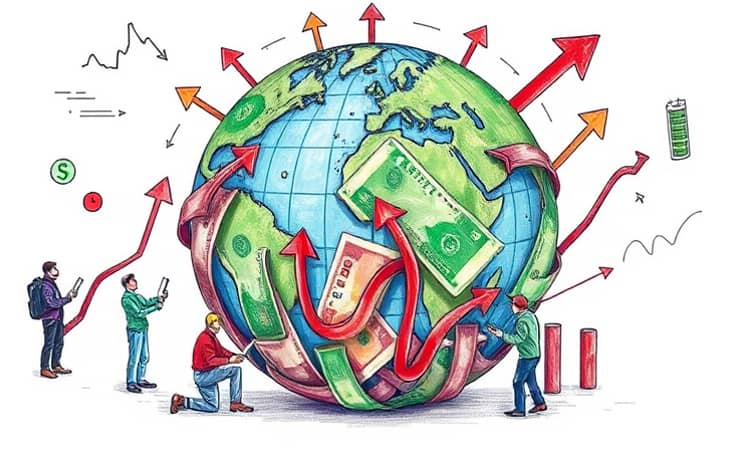
Global debt continues to climb to unprecedented levels, weighing on economies and future prospects. As of early 2025, total obligations exceed $346 trillion, representing more than 310% of world GDP.
In this article, we unpack the global debt surpassing historic thresholds, examine regional disparities, analyze key vulnerabilities, and propose targeted responses for a sustainable path forward.
The urgency of addressing high debt stems from its capacity to amplify economic shocks and constrain future policy options. By understanding the contours of this challenge, stakeholders can develop tailored strategies to mitigate risks and promote resilient growth.
The Current Landscape of Global Debt
By 2024, total global debt stood at around $251 trillion, equivalent to 235% of world GDP. Private borrowing declined to 143% of GDP—its lowest since 2015—while public obligations rose to nearly 93% of GDP. Government deficits averaging 5% of GDP, along with pandemic relief measures and rising financing costs, have driven sovereign debts higher.
Private debt dynamics reflect household deleveraging and stable corporate balance sheets in advanced economies. Excess savings accumulated during lockdowns and conservative lending practices contributed to a temporary easing of leverage pressures in 2024. Yet in key emerging markets, corporate borrowing has rebounded, funding energy transitions and digital infrastructure projects.
Further, the Institute of International Finance reported that over the first three quarters of 2025 global debt swelled by an additional $26 trillion, fueled primarily by government issuance in both mature and emerging economies. Non-financial corporate debt approached $100 trillion, largely underpinned by investment in AI research and clean energy projects.
Looking ahead, analysts warn of debt ratios outpacing economic growth amid higher real interest rates, slower productivity gains, and demographic headwinds. Without decisive measures, public liabilities could surge to 120% of GDP in advanced markets and 80% in emerging economies by 2028, leaving little room for future stimulus or crisis response.
As fiscal space shrinks, many governments face the dilemma of balancing near-term support with long-term sustainability. Some advanced economies have begun to taper pandemic-era stimulus, while several developing nations are negotiating restructuring deals to ease debt service burdens. The interplay between policy decisions and market sentiment will be critical in determining whether these measures succeed in restoring confidence.
Regional Debt Disparities
Debt profiles vary widely across income groups and countries. Advanced economies carry the largest public burdens: the United States tops the list at 121% of GDP, while the euro area hovers around 110%. Japan, despite recent declines, still maintains a debt ratio exceeding 200% of GDP, reflecting decades of stimulus and demographic challenges.
In contrast, emerging markets (excluding China) average public debts of 56% of GDP, with marked variations. Latin American economies such as Argentina and Brazil face pressures from high interest rates and volatile capital flows, whereas India and Mexico have leveraged foreign borrowing to finance long-term infrastructure investments.
China presents a unique case, with public debt rising to 88% of GDP even as private liabilities swell to 206%—driven by corporate leverage during a property sector downturn. Authorities have signaled cautious support for developers while encouraging cleaner financing channels to stabilize markets.
Low- and middle-income countries outside of China face a different challenge: external debt service has doubled over the last decade, with record net outflows of $741 billion between 2022 and 2024. Such pressures have forced cuts in public services and constrained poverty alleviation programs.
Within this landscape, the divergence between public and private credit patterns underscores the need for tailored strategies. Advanced economies may focus on tightening fiscal policy, while emerging nations must balance borrowing for growth with the risk of currency mismatches and roll-over crises.
Key Risks of High Indebtedness
Elevated leverage poses multifaceted threats to global stability. When public debt exceeds 90% of GDP, historical data suggests a higher probability of growth slowdowns and fiscal distress. Private credit booms often precipitate painful corrections, especially for households and small businesses lacking diversified income streams.
Moreover, interconnected financial systems mean that shocks in one market can quickly propagate across borders. Banks heavily exposed to sovereign bonds may face capital shortfalls if yields spike. Likewise, currency depreciation in emerging economies can convert external liabilities into domestic hardships.
- Financial stability under severe stress occurs as banks and governments become tightly interlinked, magnifying vulnerabilities in downturns.
- Debt service crowding out essential spending in social protection, health care, and infrastructure, particularly in low-income countries.
- Heightened exposure to sudden rate hikes that transmit through benchmark yields and raise funding costs for both public and private borrowers.
- Risk of sovereign restructurings or defaults with attendant fire sales, asset price collapses, and austerity measures that erode living standards.
Geopolitical and macroeconomic shifts further complicate the picture: higher defense budgets, accelerated energy transitions, and climate-related investments often compete for limited fiscal resources. Analysts warn that inadequate preparation for rising yields could trigger systemic crises and require costly bailouts.
Effective Policy Responses
Facing this precarious outlook, policymakers must act swiftly to secure debt sustainability and reignite growth. Evidence suggests a combination of fiscal prudence and targeted investment can reverse deleterious trends and restore market confidence.
Fiscal authorities should pursue gradual and credible fiscal adjustments through medium-term budget frameworks, including phased tax reforms and expenditure reviews. Prioritizing high-impact spending—such as on education and infrastructure—can boost productive capacity without exacerbating debt dynamics.
- Promoting private sector-led expansion through regulatory certainty, infrastructure partnerships, and innovation incentives that leverage public resources.
- Enhancing multilateral financing solutions by scaling concessional loans to vulnerable low-income countries and reducing borrowing costs in adverse conditions.
- Strengthening macroprudential frameworks to limit risk in credit markets and ensuring that financial institutions maintain robust buffers against shocks.
- Leveraging debt-for-investment swaps to convert existing liabilities into funding for climate adaptation, public health, and vocational training programs.
Successful implementation depends on clear communication with stakeholders, coordination among central banks and finance ministries, and engagement with multilateral institutions to mobilize technical support and concessional funding.
A Call to Action
As global debt climbs to record heights, the path forward demands a collective commitment to sustainable finance and resilient growth. Nations must align short-term adjustments with long-term strategic priorities to avoid cyclical austerity traps.
The private sector also has a role: by adhering to responsible lending standards and investing in projects with clear social returns, businesses can contribute to debt stabilization while fueling innovation.
Time is of the essence. By understanding the risks, embracing disciplined policies, and fostering inclusive growth, the world can chart a course toward financial stability and shared prosperity—a future where debt serves as a tool for progress, not a barrier to opportunity.