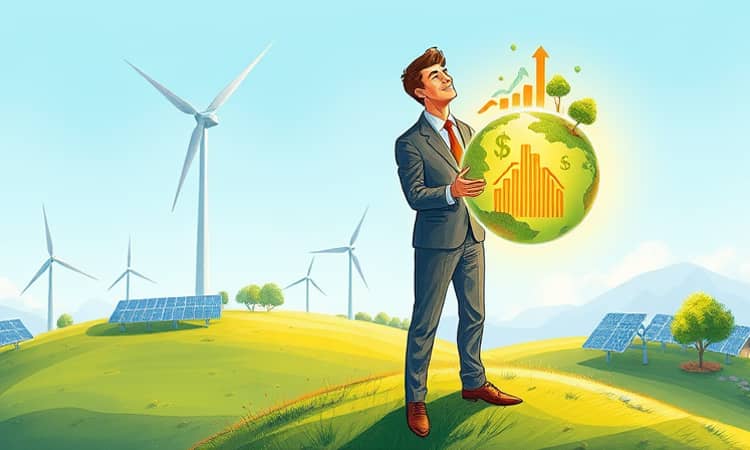
In today's rapidly evolving financial landscape, the concept of investing has transcended mere profit-seeking to embrace a broader, more meaningful purpose.
A visionary investor recognizes that building a sustainable financial legacy requires aligning capital with positive environmental and social outcomes.
This shift is not just a trend; it's a fundamental transformation driven by market demand, regulatory changes, and a growing awareness of global challenges.
The data speaks volumes: 86% of asset owners plan to increase allocations to sustainability strategies in the coming years.
This underscores a collective move towards investments that yield both financial returns and real-world impact.
By understanding these dynamics, you can position yourself to thrive while contributing to a healthier planet and society.
The Rise of Sustainable Investing
Sustainable investing has demonstrated remarkable resilience, outperforming many traditional equity markets in recent years.
In 2025, 16 out of 28 sustainable-themed stock cohorts beat global equities, highlighting its robust market performance.
Key drivers include materials supporting circular economies and grid efficiency, which have led thematic growth.
Investor sentiment is overwhelmingly positive, with 73% of global institutional investors reporting growth in assets aligned with sustainable criteria.
This momentum is particularly strong in regions like Southeast Asia, where adoption rates reach 80%.
To capitalize on this, focus on sectors that integrate sustainability into their core business models.
Key Investment Priorities for 2026
The top investment priorities for the near future center on energy efficiency and renewable energy, as identified by nearly 1,000 institutional investors worldwide.
Climate adaptation follows closely, shifting from a defensive strategy to a growth engine as physical risks become economic realities.
- Climate adaptation offers a potential market opportunity of $9 trillion by 2050.
- Energy transition is critical, with nuclear energy gaining acceptance for energy security.
- Natural capital investments must triple by 2030 to address biodiversity loss.
- Critical minerals like copper and lithium are in high demand due to electrification trends.
Adaptation bonds, for instance, reached $572 billion in issuance in 2024, showcasing viable financial instruments.
Embrace these themes to diversify your portfolio and tap into emerging growth areas.
Navigating Environmental, Social, and Governance Factors
ESG considerations are no longer optional; they are integral to risk management and value creation.
Environmental priorities now include biodiversity and water scarcity, which are becoming investable themes.
- Social factors highlight AI's impact on employment and labor markets.
- Governance focuses on shareholder rights and regulatory engagement.
Active stewardship and engagement with companies can enhance long-term returns and societal benefits.
By integrating ESG diligence, you mitigate risks and uncover opportunities that others might overlook.
The Policy and Regulatory Landscape
Policy support for sustainable investing is dynamic, with frameworks evolving to standardize practices.
For example, the EU's Sustainable Finance Disclosure Regulation influences private capital markets globally.
- SBTi commitments rose 23% year-over-year, with a revised standard expected in 2026.
- Nature-related disclosures are expanding, creating new market infrastructure.
Carbon pricing now covers 28% of global emissions, incentivizing greener practices.
Stay informed on regulatory changes to align your investments with compliance and innovation.
Sector Opportunities and Portfolio Positioning
Industrials show the largest overweight relative to global equities, reflecting interest in energy efficiency and renewable supply chains.
This sector benefits from circular economy initiatives and green capital expenditure.
- Homebuilders and consumer staples are relevant for biodiversity-related opportunities.
- Grid efficiency and renewable energy supply chains offer stable growth prospects.
Below is a table summarizing key investment themes and their potential impacts:
Use this guidance to overweight sectors that align with sustainability goals for balanced returns.
Financing the Future
Mobilizing capital for sustainable projects requires innovative financing mechanisms.
Private sector participation in adaptation remains limited at $4.7 billion annually, despite vast needs.
- Green bonds and debt-for-nature swaps are essential for scaling natural capital.
- Blended finance models combine public and private capital to bridge funding gaps.
Concessional financing and green tax incentives can catalyze investments in emerging markets.
By exploring these tools, you can contribute to global climate finance targets while earning competitive returns.
AI's Dual Role in Sustainable Investing
Artificial intelligence presents both opportunities and challenges for sustainable finance.
On one hand, AI improves ESG data analysis and climate risk modeling, becoming essential for predictive analytics.
- AI-driven productivity enhancements can offset labor market pressures in aging economies.
- Applications in supply chain transparency bolster ESG diligence.
However, AI's rapid expansion pressures energy supplies and raises social concerns about employment.
Navigate this by supporting AI use cases that prioritize sustainability and ethical considerations.
Strategic Investor Outlook for Success
To succeed in 2026, view resilience as a growth market rather than just a risk hedge.
Prioritize active engagement and stewardship to influence corporate behavior positively.
- Disentangle economic, political, and legal risks with a clear strategic focus.
- Capitalize on diverging dynamics between electrostates and petrostates in energy markets.
Improved data transparency is critical for reducing investment risks and unlocking returns.
By adopting this mindset, you can build a portfolio that thrives amid uncertainty.
Overcoming Market Challenges
Geopolitical dynamics, such as China's dominance in cleantech production, reshape investment landscapes.
Trade diplomacy increasingly centers on critical minerals access, presenting both risks and opportunities.
Perception barriers often view adaptation as a cost, but reframing it as a growth opportunity is key.
Private sector investments must compete with funding for defense and AI infrastructure.
Interest rate normalization affects renewable energy dynamics, requiring adaptive strategies.
Address these challenges by diversifying geographically and staying agile in your approach.
Looking Ahead: Building Your Legacy
Building a sustainable financial legacy is a journey that blends profit with purpose.
Start by assessing your current portfolio for alignment with sustainability criteria.
Engage with financial advisors who specialize in ESG and impact investing.
Consider allocating funds to thematic ETFs or direct investments in green projects.
Monitor policy developments and adjust your strategy accordingly to stay ahead.
Remember, every investment decision shapes the future—choose wisely to leave a lasting, positive mark.