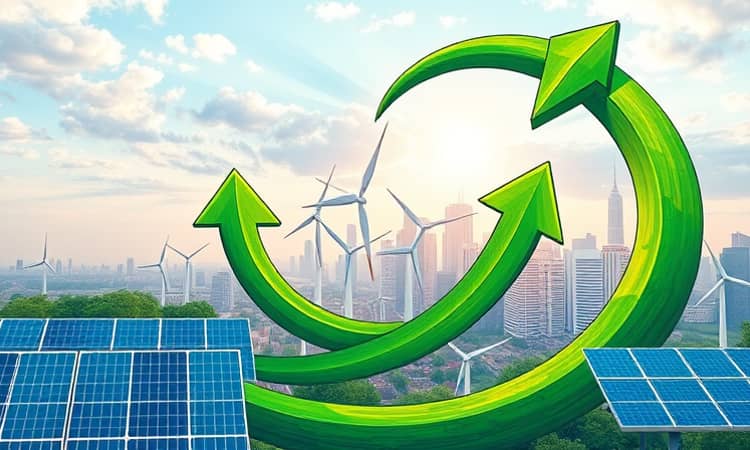
In a world grappling with climate change, resource scarcity and market volatility, investors seek opportunities that align profit with purpose. The concept of a self-reinforcing positive feedback loop—known as a virtuous cycle—provides a powerful framework. In such a system, each gain fuels further gains, generating compounding benefits over time for both the environment and financial returns.
By channeling capital into sustainability, we can create interlocking cycles of growth and resilience. This article explores the foundations of virtuous investment cycles, examines economic precedents, illustrates concrete sustainability loops, and presents compelling evidence that “green” can indeed be “profitable.”
Conceptual Foundations of Virtuous Cycles
A virtuous cycle is a chain of events in which each outcome strengthens the next. In economics and business, such cycles accelerate progress through exponential rather than linear growth. Unlike a vicious cycle of decline, a virtuous cycle remains relatively self-sustaining once established.
- Positive feedback loop: amplification of each benefit
- Compounding effects: growth builds on growth
- Sustainability: enduring upward momentum
- Contrast with vicious cycle: spiral of decline
Virtuous Cycles in Modern Economic Systems
Virtuous cycles already underpin industrial and capital-market success. For example, higher employment drives wages upward, boosting consumption, which in turn lifts business profits and fuels further investment. Similarly, infrastructure spending yields productivity gains, expands the tax base and finances more public works.
Efficient capital markets themselves exemplify a virtuous economic cycle. They channel long-term savings into productive innovation and offer risk-management tools like index funds. As participation broadens, markets deepen, costs fall and access widens—a virtuous cycle of market development.
Green Growth: Sustainability as a Growth Driver
The transition to renewable energy and circular economy models demonstrates how environmental investments can spark virtuous circles. According to the European Investment Bank, moving to renewables reduces carbon emissions, cuts energy import dependence, and lowers long-run costs—boosting competitiveness and resilience.
In a circular economy, smart product design leads to easier material recovery, raising recycled content and lowering reliance on virgin resources. This creates cheaper, competitive products and incentivizes further design-for-disassembly and recycling investments.
This table highlights dramatic cost declines over a decade, illustrating the scale-driven cost curve cycle in renewables. As costs fall, deployment accelerates, attracting more capital and policy support, which further drives down prices.
Eight Archetypal Sustainability Loops
Investors and companies can tap into multiple virtuous loops where environmental initiatives boost financial outcomes, enabling reinvestment in green projects:
- Energy-efficiency savings cycle: Efficiency upgrades drive lower energy bills, higher margins and more capital for further upgrades.
- Renewables adoption curve: Scale and learning-by-doing reduce costs, spurring further renewable investments.
- Brand and pricing power cycle: Strong ESG practices build loyalty, allow price premiums and finance more innovation.
- Human capital productivity loop: Health and wellness initiatives reduce absenteeism, boost output and fund further employee programs.
- Innovation and R&D cycle: Profits from sustainable offerings fuel research into cleaner technologies and products.
- Capital-market access loop: High ESG ratings lower cost of capital, enabling more green investments and risk improvement.
- Community license-to-operate: Local engagement and development strengthen reputation, ease approvals and support profitability.
- Circular-economy resource productivity: Design for reuse lowers input costs, enhances compliance and reinvestment capacity.
Good for Pocket: Financial Performance and Risk Management
Sustainability investments offer robust financial and risk management advantages. By reducing exposure to energy price volatility, regulatory fines, and supply-chain disruptions, green investments act as a hedge against downside risks.
- Downside protection: Climate risks and resource shortages drive higher insurance and mitigation costs.
- Return enhancement: Studies show ESG-integrated portfolios often match or outperform benchmarks.
- Capital efficiency: Lower operating costs improve cash flow and valuation multiples.
- Reduced cost of capital: Access to green bonds and sustainability-linked loans lowers financing expenses.
Morningstar research indicates that sustainable funds have experienced fewer severe drawdowns during market stress, demonstrating greater resilience. Moreover, companies with strong ESG profiles enjoy higher ratings from rating agencies, attracting long-term, stable investors.
Case Studies and Evidence of Profitability
Numerous reports highlight that “green” is profitable. For instance, energy-efficiency upgrades in manufacturing have delivered payback periods as short as two to three years, with average savings of 20–30%. In the corporate sector, firms with top-quartile ESG performance achieved a 4.8% higher return on equity on average.
Similarly, renewable energy projects have become cost-competitive without subsidies in many regions. BloombergNEF reports that 72% of global utility-scale solar projects and 90% of onshore wind projects can now produce power below $60/MWh. This cost parity unlocks new markets and erodes the fossil-fuel cost advantage.
Building Your Own Virtuous Investment Strategy
To harness these cycles, investors can:
- Prioritize opportunities with clear environmental and financial synergies.
- Assess lifecycle cost savings and potential for reinvestment.
- Leverage green financing instruments to optimize capital structure.
- Monitor performance metrics that capture both impact and returns.
By doing so, portfolios can generate steady returns while contributing to a low-carbon, resilient economy.
Conclusion: A Win–Win for Planet and Pocket
The virtuous investment cycle represents a transformational approach to capital allocation. By embracing sustainability not as an expense but as a strategic driver, investors and companies can tap into compounding environmental and financial benefits. The evidence is clear: green investments can deliver competitive returns, lower risks and create lasting value for all stakeholders.
In an era of urgent climate challenges, aligning profit with purpose through these virtuous cycles offers a path to prosperity that is both enduring and inclusive. It is, quite simply, good for planet, good for pocket.