Business success is no longer measured by financial gains alone. The triple bottom line expands this narrow view to include social and environmental impacts.
This framework, known as TBL or 3BL, was introduced by John Elkington in 1994. It aims to push companies towards a more regenerative and sustainable future.
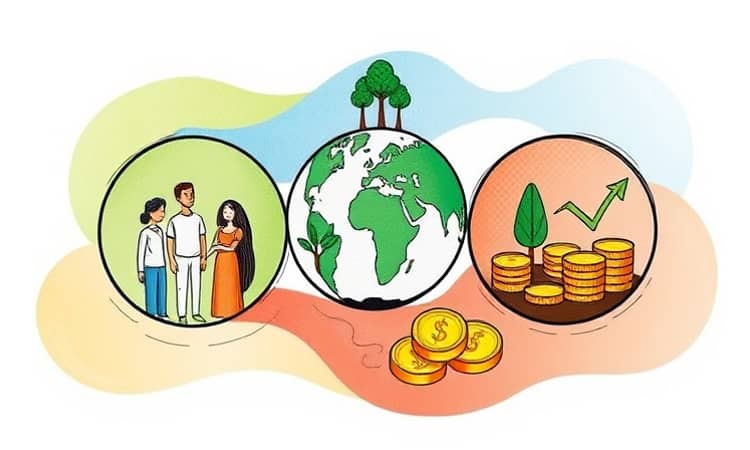
By considering People, Planet, and Profit together, businesses can achieve a harmonious balance. This holistic approach fosters resilience and long-term value creation.
What is the Triple Bottom Line?
The triple bottom line is a business framework that broadens success measurement. It includes social (People), environmental (Planet), and financial (Profit) performance.
Historically, businesses focused solely on the financial bottom line. This shift in perspective recognizes that profit alone is insufficient for true value.
Elkington's vision was to encourage firms to rethink capitalism and integrate broader responsibilities. This has influenced modern concepts like ESG and impact investing.
It is grounded in systems thinking, where People, Planet, and Profit are interconnected. This interdependence is the foundation for powerful synergy.
Deep Dive into the Three Ps
Each P represents a critical dimension of performance. Understanding them individually is key to grasping their synergy.
Let's explore People, Planet, and Profit in detail. This deep dive will reveal practical metrics and examples.
People: The Social Bottom Line
The People dimension focuses on social well-being. It covers employees, communities, customers, and supply chains.
Key questions include fairness in working conditions and investment in communities. Investing in people leads to numerous business benefits.
- Labor practices: Fair wages, safe conditions, diversity, and training.
- Community impact: Local hiring, charitable contributions, and economic development.
- Customer well-being: Product safety, ethical marketing, and data privacy.
Metrics for People help track social performance. They include average training hours and employee turnover rate.
These indicators are crucial for reporting and improvement. They show a company's commitment to social responsibility.
Planet: The Environmental Bottom Line
Planet assesses a company's environmental footprint. It involves resource use, emissions, waste, and ecosystem restoration.
Questions revolve around carbon emissions and resource efficiency. Environmental initiatives often yield cost savings.
- Resource use: Energy and water consumption, use of recycled materials.
- Emissions and pollution: Greenhouse gases, air and water pollutants.
- Waste and circularity: Waste reduction, product take-back, circular models.
- Environmental restoration: Reforestation, regenerative agriculture, biodiversity.
Example metrics are greenhouse gas emissions and water consumption. IKEA's waste recycling saved over $1 million annually.
This demonstrates how environmental actions can boost profit. It aligns with the synergy at the heart of TBL.
Profit: The Financial Bottom Line Redefined
Profit in TBL includes traditional financial metrics but reframes them. It emphasizes long-term, ethical, and resilient financial health.
Components include revenue growth, cash flow stability, and ethical behavior. Profit enables social and environmental innovation.
- Financial health: Revenue, profitability, access to capital.
- Ethical behavior: Fair tax payments, avoidance of corruption.
- Economic contribution: Job creation, support for local suppliers.
Metrics like net income and ROI are still crucial. This redefinition ties profit to broader stakeholder benefits.
This table summarizes key metrics for each P. It helps businesses track and communicate their TBL performance.
The Synergy Effect: Mutual Reinforcement
The true power of TBL lies in the synergy between People, Planet, and Profit. They are interconnected and reinforce each other.
This synergy reduces risks and enhances resilience. Companies that integrate TBL are better prepared for market shifts.
- Risk reduction: Lower regulatory and reputational risks.
- Cost savings: Energy efficiency and waste reduction cut costs.
- Market differentiation: Responsible brands attract loyal customers.
- Talent attraction: Purpose-driven companies retain motivated employees.
- Investor interest: ESG investing favors TBL-performing firms.
For instance, IKEA's environmental efforts boosted profits while benefiting the planet. This virtuous cycle demonstrates the business case for TBL.
Synergy transforms TBL from a checklist into a dynamic system. It drives innovation and sustainable growth.
Limitations and Future Directions
Despite its benefits, TBL has criticisms. Some argue it can be vague or difficult to measure.
Challenges include greenwashing and the complexity of integration. Future models like B Corps and regenerative business address these.
- Measurement issues: Standardizing metrics across industries.
- Implementation barriers: Cost and resistance to change.
- Evolving frameworks: ESG, SROI, and circular economy models.
The journey towards sustainable business is ongoing. Embracing TBL principles can guide companies to a prosperous future.
By adopting this framework, businesses can thrive while making a positive impact. The triple bottom line boost is a call to action for a better world.
Start by assessing your current practices. Set clear goals for People, Planet, and Profit.
Engage stakeholders and communicate your progress. This practical approach ensures meaningful change.
Remember, TBL is about creating value for all. It inspires a new era of responsible and successful business.