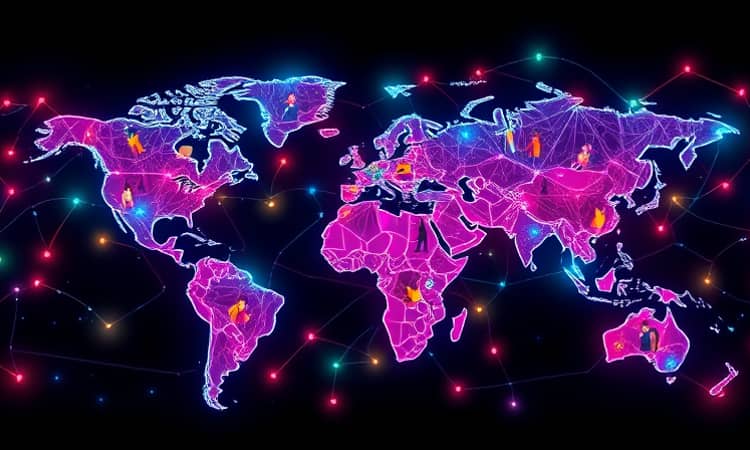
Across continents and communities, the digital revolution has reshaped commerce, education, and social life. Yet, a persistent chasm separates those who thrive in connected environments from those left offline. Understanding this divide is critical if we are to forge inclusive, innovative global digital economies.
Understanding the Current State of Connectivity
The term unequal access to connectivity captures how millions lack reliable internet or devices. The digital divide encompasses four core dimensions:
- Connectivity and affordability: broadband, mobile, 5G access and cost.
- Devices and hardware: computers, smartphones, tablets.
- Digital skills and literacy: the capabilities to leverage online tools.
- Regional and demographic gaps: urban–rural, income, gender, race.
Data from ITU, DataReportal, and Statista converge on one fact: roughly 2 to 2.6 billion people remain offline in 2025. The ITU reports 6 billion users globally, leaving 2.2 billion unconnected. DataReportal counts 5.56 billion users with 2.63 billion offline, while Statista puts internet adoption at 6.04 billion. These variations underscore the challenge of measurement but paint a clear picture of a dynamic, evolving gap.
Fifth-generation networks illustrate stark contrasts. Globally, 55% of inhabitants enjoy 5G coverage, but this reaches 84% in high-income nations versus just 4% in low-income countries. Bridging these disparities is not solely a technical mission—it is a development imperative.
Mapping the Divide onto Economic and Social Inequality
Connectivity mirrors and magnifies existing inequalities. Wealthier nations with robust infrastructure enjoy near-universal access, while emerging economies grapple with limited investment, policy fragmentation, and geographic barriers. Within countries, the gap splits along income, race, and geography.
Even in advanced economies, digital scars appear. In the United States, households earning under $30,000 annually face multiple barriers: 27% rely on smartphones alone for internet, and 13% lack any device. By contrast, high-income households report nearly universal access. Racial disparities compound these economic divides. Black and Hispanic families are significantly more likely to lack home broadband, while Indigenous communities on tribal lands see about half without basic connectivity or a home computer.
Macroeconomic Impacts: Growth and Opportunity Left Behind
Connectivity is growth infrastructure. Empirical evidence links a 10% boost in broadband penetration to a 1.21% GDP rise in developed nations and 1.38% in developing ones. In the U.S. alone, a 10% broadband expansion in 2014 could have generated 875,000 jobs and $186 billion in additional output by 2019.
Mobile technologies amplify this effect. In 2021, the mobile economy contributed $4.5 trillion—about 5% of global GDP. This economic value of connectivity underlines why underserved regions endure slower growth, fewer job opportunities, and diminished competitiveness in global markets.
At the individual level, digital skills translate to pay premiums. Jobs requiring baseline digital literacy pay roughly 17% more than non-digital roles. Middle-skills positions demanding some digital competency offer wages around $20 per hour—nearly three times the U.S. federal minimum. When millions lack access or skills, entire segments of the workforce remain trapped in lower-wage, less stable occupations.
Strategies and Investments to Close the Gap
Closing the digital divide demands a multifaceted, sustained approach. Stakeholders must align on targets, resources, and timelines to ensure inclusive, resilient connectivity for all.
- Infrastructure investment: expand fiber, satellite, and 5G networks in underserved areas.
- Affordability programs: subsidies, zero-rating data plans, and device financing schemes.
- Digital literacy initiatives: community training centers, online courses, and mentorship programs.
- Public-private partnerships: leverage corporate expertise and government support for universal service funds.
- Regulatory frameworks: streamline permits, encourage competition, and protect consumer rights.
Effective programs blend top-down funding with grassroots engagement. For example, universal service funds can finance network expansion while local NGOs deliver tailored digital skills training. Solar-powered community Wi-Fi stations and low-earth-orbit satellite constellations offer technical solutions for remote regions. Meanwhile, coordinated policy reforms—such as reducing spectrum costs and incentivizing affordable device manufacturing—unlock long-term sustainability.
Investments in digital literacy are equally vital. Classroom technology upgrades must pair with teacher training and curriculum updates that focus on coding, critical thinking, and online safety. Public libraries, community centers, and mobile learning labs serve as hubs for upskilling. By empowering individuals with practical skills, societies transform connectivity into opportunity.
A Call to Collective Action
The tech divide is more than a statistic; it is a barrier to human potential. Bridging this gap requires governments, industry leaders, civil society, and communities to unite behind a shared vision of equitable digital opportunity. Ambitious targets—such as universal broadband by 2030—must be matched by concrete action plans, transparent monitoring, and flexible adaptation to local realities.
Now is the moment to invest boldly. Every dollar spent on connectivity infrastructure typically yields multiples in economic output, enhanced education outcomes, and social inclusion. Policymakers must remove obstacles, industry must innovate affordably, and communities must engage actively in co-creating solutions.
Together, we can reshape the digital landscape, ensuring that no individual or region is left behind. By bridging the tech divide, we unlock new markets, foster innovation, and build a future where every person can participate fully in the global digital economy.