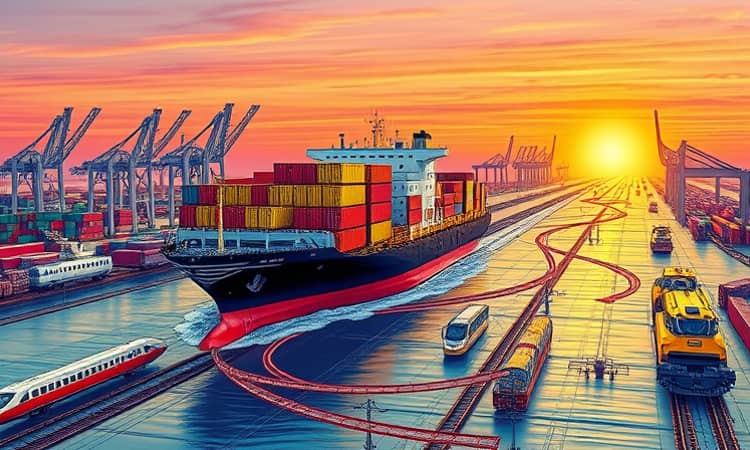
From camel caravans to container ships, Asia is rewriting the history of global trade with unparalleled momentum.
From Ancient Caravans to Digital Trade Routes
The ancient network of overland and maritime routes known as the Silk Road connected China’s Xi’an with Central Asia, the Middle East, and Europe from the 2nd century BCE to the mid-15th century. Traders carried silk, spices, ceramics, and metals, while ideas, religions, and art flowed alongside goods.
Today’s trade landscape has evolved into a dynamic containerized ecosystem, fueled by high-speed rail, mega-ports, and real-time data. Yet, the spirit of that early globalization endures in every shipment crossing continents.
Belt and Road Initiative: Building the Modern Silk Road
Launched in 2013, the Belt and Road Initiative (BRI) seeks to revive and modernize Silk Road connectivity through two pillars:
- Silk Road Economic Belt: Overland rail and road corridors linking China to Europe via Central Asia.
- 21st-Century Maritime Silk Road: Sea routes from China to Southeast Asia, Africa, and the Mediterranean.
With more than over US$1 trillion in investments, China has financed ports, railways, and pipelines in over 70 countries. In the first half of 2025 alone, new BRI agreements topped US$124 billion, underlining its unstoppable expansion despite geopolitical scrutiny.
The initiative aims to stimulate domestic growth in underdeveloped regions, open new markets for Chinese products, and channel excess industrial capacity abroad. Strategic corridors such as the Khorgos Gateway in Kazakhstan, handling around 500,000 containers annually, and headline projects like the Jakarta–Bandung high-speed rail and Gwadar port in Pakistan, have become modern incarnations of Silk Road hubs.
Asia as the New Trade Engine: Global Momentum
Despite recent tariffs and tensions, global trade surged by about US$500 billion in the first half of 2025 versus 2024. Goods trade growth accelerated from roughly 2% to 2.5% quarter-on-quarter, while services rebounded strongly.
- Global goods trade up 6% year-on-year in H1 2025, triple the previous period.
- Asia and Latin America lead recovery, with China and Taiwan posting double-digit export growth.
- Hinrich Foundation raises merchandise trade volume growth forecast from 0.9% to 2.4% for 2025.
These numbers signal that Asia is not only weathering uncertainty but powering the next wave of globalization.
Asia’s Macro Weight in the New Silk Road Era
The IMF projects that the Asia-Pacific region will deliver about 60% of global growth in 2025 and 2026, driven by front-loaded exports, intra-regional supply-chain reconfiguration, and heavy investment in AI and advanced technologies.
This robust domestic growth base underpins Asia’s centrality in shaping global trade patterns, contrasting with slower expansion in Europe.
Asia’s Changing Trade Geography and Patterns
In the first half of 2025, global trade grew faster than any half-year since 2010, excluding the post-pandemic rebound. Of the ten fastest-growing trade lanes among the world’s largest, six originated in Asia, underscoring its pivotal role.
- Hong Kong SAR, Thailand, Malaysia, and Vietnam rank among the top ten fastest-growing traders.
- East Asia & Pacific intra-regional trade share rose from 55% to 56%.
- Average trade distances in Thailand fell by 79 km, and in China by 76 km, reflecting shorter supply chains.
Moreover, ASEAN has overtaken the U.S. as China’s top export destination. In the first eight months of 2025, Chinese exports to ASEAN rose by 15%, fully offsetting a 15% decline to the U.S. This shift highlights a re-centering of trade flows within Asia.
Regional Case Study: Xinjiang as a Revived Silk Road Gateway
Xinjiang, historically a caravan crossroads, has re-emerged as a modern logistics hub. In 2024, its import-export value soared to 435.11 billion yuan (≈US$60 billion), up 21.8% year-on-year, ranking third among all Chinese provinces.
Trade with BRI partners grew 18.7% in 2024, while exports to RCEP and ASEAN members rocketed by 167.8% and 191.9%, respectively. The November 2023 launch of the China (Xinjiang) Pilot Free Trade Zone accelerated reforms, streamlining customs and boosting cross-border e-commerce.
With cutting-edge logistics parks, bonded warehouses, and multimodal corridors linking rail, road, and air, Xinjiang exemplifies how infrastructure and policy innovation can transform a gateway region into a trade powerhouse.
Practical Insights for Businesses and Policymakers
As Asia’s trade renaissance unfolds, stakeholders can take concrete steps to harness its opportunities:
First, businesses should embrace regional partnerships and joint ventures to navigate local regulations and cultural nuances. Collaborative investments in Southeast Asian manufacturing and logistics hubs can yield high returns.
Second, companies must leverage digital platforms and trade finance tools to streamline cross-border transactions. Technologies such as blockchain-based letter of credit systems and AI-driven demand forecasting can reduce risk and accelerate cash flow.
Finally, policymakers should continue to foster open markets, support infrastructure spending, and eliminate non-tariff barriers. Harmonizing standards and promoting seamless customs procedures will amplify the benefits of emerging corridors.
A Vision for the Future
The rebirth of the Silk Road in the 21st century is more than a metaphor—it is a testament to Asia’s capacity to innovate, connect, and lead. From the sun-scorched deserts of Central Asia to the high-tech ports of Southeast Asia, the threads of ancient exchange are woven into a digital tapestry of trade.
As Asia cements its role as the world’s growth engine, every stakeholder—from small exporters to global policymakers—has a part to play in this grand narrative. By embracing collaboration, investing in infrastructure, and harnessing technology, we can ensure that the Silk Road Reloaded remains a beacon of prosperity for generations to come.