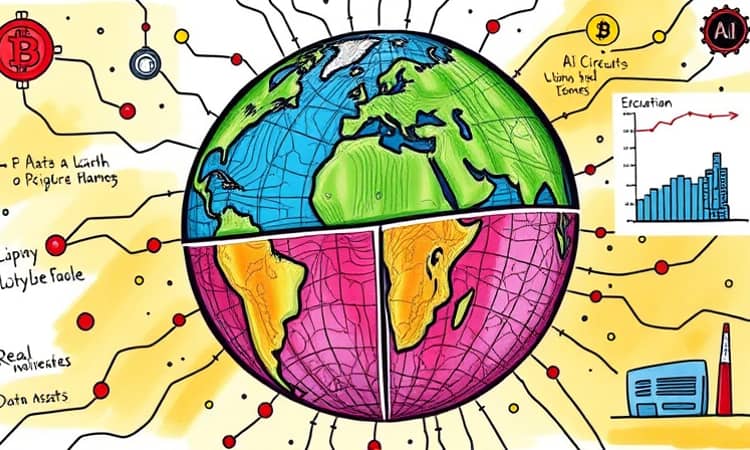
We stand at a pivotal moment in history, where the global economy is undergoing a dramatic transformation.
**Old certainties are fading fast**, replaced by new forces that challenge traditional investment strategies.
This article explores how artificial intelligence, geopolitical shifts, and inflationary pressures are reshaping markets.
By understanding these changes, you can position yourself for success in the evolving landscape.
The New Macro Backdrop: From Globalization to Fragmentation
The pre-2020 era was defined by hyper-globalization and stable financial conditions.
Key features of that period included falling inflation and deep global supply chains.
Low or negative real rates in developed markets were common.
Financial assets, especially U.S. growth stocks, consistently outperformed real assets.
Now, the world is shifting towards a new paradigm marked by fragmentation and uncertainty.
This shift is driven by deglobalization trends and strategic industrial policies.
Trade wars and tech sanctions are reshaping international relations.
Parallel monetary and trading blocs are emerging, altering capital flows.
This environment creates both risks and opportunities for investors.
- Falling inflation and cheap labor characterized the old model.
- Deep global supply chains enabled cost efficiencies.
- Outperformance of financial assets was a hallmark of the era.
Understanding this backdrop is crucial for navigating future investments.
Key Global Forces Shaping the Future
Three powerful forces are at the core of the new economic landscape.
**Artificial intelligence leads the charge** as a transformative megatrend.
AI is driving changes in productivity, sector returns, and labor markets.
Geopolitical and monetary fragmentation is redefining global interactions.
This includes supply chain reconfigurations and currency system shifts.
Persistent inflationary pressure remains a key concern despite recent disinflation.
These forces interact to create a complex market environment for 2026 and beyond.
- AI as a structural driver of growth and innovation.
- Fragmentation affecting trade and geopolitical stability.
- Inflation staying above historical targets in many regions.
Recognizing these forces helps in building resilient portfolios.
Economic Outlook for 2026: Scenarios and Numbers
Institutional forecasts for 2026 highlight varied growth and inflation scenarios.
Vanguard projects an up to 60% chance of 3% real GDP growth in the U.S.
This is driven by AI capital investment and productivity gains.
Baseline expectations for 2026 U.S. growth are around 2.25% real GDP.
Supporting factors include AI-related spending and fiscal stimulus.
Wealth effects from strong equity markets also play a role.
Morgan Stanley emphasizes the AI CapEx boom as a demand-side driver.
Later phases will see AI become a supply-side factor with productivity benefits.
Labor markets are expected to remain tight with unemployment below 4.5%.
- AI capital investment boosting economic activity.
- Fiscal thrust from legislative packages supporting growth.
- Strong upper-income consumption driving demand.
These scenarios underscore the importance of monitoring AI adoption.
Regional differentiation is critical for investment decisions.
Debt, Fiscal Policy, and the Rise of Real Assets
High public debt levels pose significant challenges for many economies.
**The U.S. faces a toxic mix** of debt and industrial weaknesses.
Options for addressing this include austerity or inflating away the debt.
Austerity is often seen as politically unviable in democratic systems.
Persistent moderate inflation and financial repression are more likely paths.
Financial repression involves keeping real rates low to manage debt burdens.
Re-industrialization efforts are gaining momentum in the U.S. and Europe.
This includes onshoring critical supply chains like chips and batteries.
Heavy capital investment in manufacturing and infrastructure is underway.
However, re-industrialization margins are structurally lower than in financialized sectors.
This shift supports a rotation towards real-economy capital and real assets.
**Real-asset revaluation is becoming a key theme** for investors.
- Onshoring of supply chains for security and resilience.
- Investment in data centers and electricity generation.
- Real estate near infrastructure grids gaining value.
Focusing on tangible assets can hedge against inflationary pressures.
AI as a General-Purpose Technology: Investment Cycles and Impact
AI is not just a trend but a general-purpose technology reshaping economies.
Vanguard's AI exuberance framework highlights its central role.
The AI CapEx cycle is still in its early stages with room for growth.
**Multiple phases define this transformation**, from information tech to broader sectors.
Short-term, AI acts as a demand-side driver boosting GDP and earnings.
Medium-term, it becomes a supply-side force with productivity enhancements.
Historical parallels, like the 1990s productivity boom, suggest gradual impacts.
Early evidence of positive productivity gains from AI is still inconclusive.
AI is set to transform labor markets through automation and augmentation.
Task automation will affect routine cognitive and clerical work.
Augmentation enables workers to expand capabilities in fields like energy and health.
New job categories are emerging in AI operations and safety domains.
- Current investment concentrated in information and telecoms.
- Future diffusion into professional services and manufacturing.
- AI-driven changes in job roles and skill requirements.
Staying ahead in AI adoption is essential for long-term growth.
Practical Investing Strategies for the New Paradigm
To thrive in this new era, investors must adapt their strategies.
Diversify into sectors benefiting from AI and re-industrialization.
**Consider real assets like infrastructure** and commodities for inflation protection.
Monitor geopolitical risks and adjust allocations based on regional strengths.
Focus on companies with strong AI integration and innovation capabilities.
Prepare for higher volatility as markets adjust to new economic realities.
Embrace a long-term perspective to capture the full benefits of these shifts.
Educate yourself on emerging technologies and their economic impacts.
Build resilient portfolios that can withstand fragmentation and inflationary pressures.
Seek opportunities in regions with young workforces and growth potential.
- Invest in AI-driven companies and real assets.
- Hedge against inflation with tangible investments.
- Stay informed on geopolitical developments.
- Adopt a flexible approach to asset allocation.
By taking these steps, you can navigate the shifting tides with confidence.
The future belongs to those who understand and act on these new paradigms.