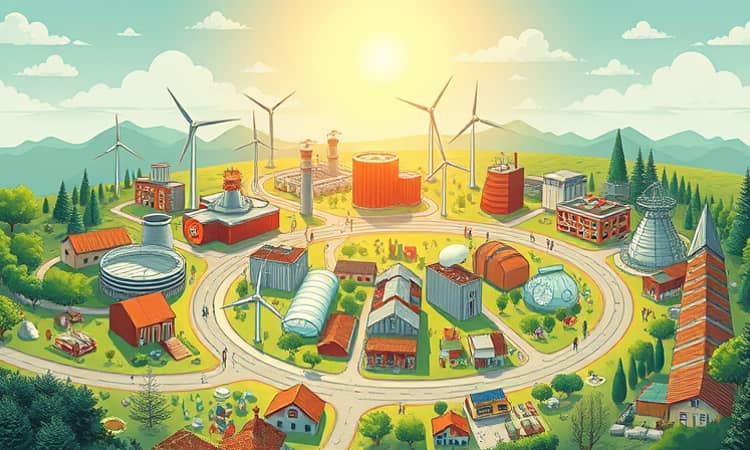
Unlocking $4.5 trillion by reimagining growth through circular, regenerative practices.
What is the Circular Economy?
The circular economy represents a transformative shift from the traditional linear “take-make-waste” model toward a system that emphasizes continuous use of products, materials, and resources. At its heart, it relies on strategies such as reuse, repair, remanufacturing, recycling, and resource recovery.
By decoupling growth from resource extraction, this model not only minimizes waste and reduces emissions but also fosters long-term environmental resilience. Studies project that circular solutions could cut new product emissions by 40% by 2050 for key materials like plastic, aluminium, cement, and steel.
Market Growth and Economic Potential
The global circular economy market was valued at USD 656.23 billion in 2024 and is projected to reach USD 2,659.39 billion by 2035 at a CAGR of 13.57%. This dynamic expansion underlines the sector’s capacity to unlock significant economic value while enhancing resource security and supply chain resilience.
Analysts estimate that by 2030, circular practices could generate up to USD 4.5 trillion in new economic opportunities. Regions such as North America are expected to grow at a CAGR of 25.65% from 2024 to 2031, while Asia-Pacific leads in adopting closed-loop water systems and e-waste recovery innovations.
Investment Landscape: Funding and Influencers
Investor confidence in circular models continues to strengthen. Over 9,200 funding rounds have closed globally, involving more than 3,000 investors and 3,750 companies, with an average deal size of USD 37 million.
- European Investment Bank: USD 890 million across 7 companies
- Temasek Holdings: USD 596 million across 6 companies
- Bain Capital: USD 519 million across 2 companies
- Credit Agricole: USD 503 million across 4 companies
- DST Global: USD 461 million across 4 companies
- JP Morgan: USD 368 million across 2 companies
Private firms like Closed Loop Partners have spearheaded this movement, making over 90 strategic investments and keeping 16 billion pounds of materials in circulation. By 2024, they avoided 25 million metric tons of GHG emissions and managed 27 processing facilities handling 3 billion pounds of resources.
Key Trends and Innovations
- Circular design guided by biomimicry principles
- Product-as-a-Service (PaaS) subscription models
- Blockchain-enabled supply chain transparency
- Bio-based materials from algae, fungi, and ag-waste
- Urban mining to recover metals from e-waste
- Collaborative consumption and sharing platforms
- Advanced remanufacturing and upcycling techniques
- Smart waste management with the Internet of Waste
- Extended producer responsibility policies
- Consumer-driven behavior change campaigns
Regional Spotlights: Global Momentum
In the United States, regional corridors have emerged: electronics recovery in the Northeast, large-scale recycling in the Midwest, citywide reuse systems on the West Coast, and material hubs in the Southwest. The EU has mobilized capital through the Ecodesign Regulation and Critical Raw Materials Act, aiming to fill an annual investment gap of EUR 29 billion.
Asia-Pacific nations, led by Singapore’s closed-loop water initiatives, South Korea’s e-waste strategies, and Japan’s material efficiency programs, represent the fastest-growing market. In the Global South, innovation hubs are fostering corporate circular strategies, blending traditional practices with cutting-edge technologies.
Policy Frameworks and Strategic Enablers
The European Green Deal’s Circular Economy Action Plan (CEAP) 2020 has been pivotal in steering finance toward sustainable patterns, aligning national plans with the broader sustainable finance agenda. Key policies include landfill bans, stringent recycling targets, and mandatory producer responsibility schemes.
National regulations are evolving to integrate digital traceability and carbon pricing, incentivizing the use of secondary materials. Industrial policies now emphasize autonomy and resilience, reflecting a domestic manufacturing push and the need to address volatile supply chains.
Measuring Impact: Metrics and Milestones
Impact measurement is central to validating circular strategies. Notable achievements to date include:
- 16 billion pounds of materials kept in circulation by Closed Loop Partners
- 25 million metric tons of GHG emissions avoided
- 90+ targeted investments in recycling and advanced recovery
- 3 billion pounds processed annually across 27 facilities
- 7.5% industry growth rate observed in the last year
Future targets aim for a 40% reduction in new product emissions by 2050 and the realization of USD 4.5 trillion in economic value by 2030.
Challenges and Opportunities Ahead
Despite robust growth, challenges remain. Infrastructure scaling requires significant capital injections—an annual gap of EUR 29 billion in the EU alone—while policy implementation varies widely by region. Integrating small and medium enterprises into global value chains demands supportive frameworks and capacity building.
Opportunities abound in community-powered systems, where local supply chains and market-driven resource efficiency unlock shared prosperity. Profitable business models coexist with environmental stewardship, demonstrating that circularity is not just a moral imperative but a proven global economic accelerator.
Conclusion
The circular economy represents a once-in-a-lifetime chance to redefine prosperity for people and planet. With more than 9,200 investments, trillions in untapped value, and a growing policy toolkit, the case for regenerative riches is compelling.
By embracing circular design, strategic financing, and collaborative innovation, we stand on the cusp of an era where growth and sustainability go hand in hand. Now is the moment to invest, innovate, and inspire—a future where nothing is wasted and everything has value.