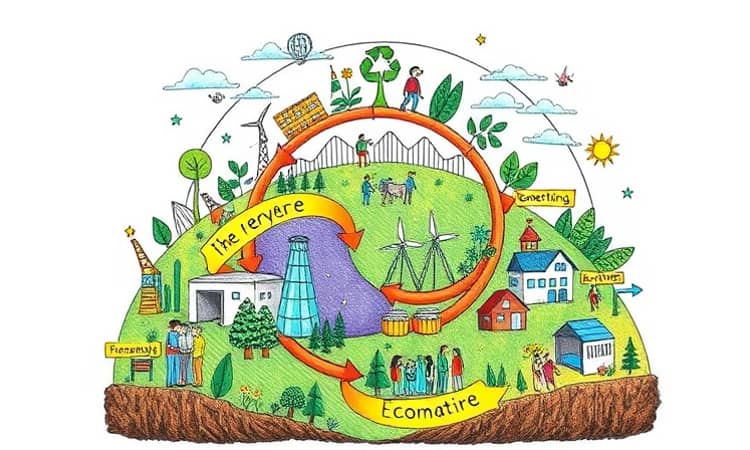
As the world confronts resource constraints and environmental pressures, investors are discovering an extraordinary frontier: the circular economy. With its promise of sustainable regeneration, this model recycles materials, redesigns products, and redefines waste as opportunity. From closed-loop plastics facilities to digital marketplaces for refurbished goods, the circular economy offers both financial returns and positive planetary impact.
In this comprehensive article, we explore the market dynamics, technological innovations, funding ecosystems, policy frameworks, and risk factors shaping this space. Our goal is to inspire action and equip you with practical insights to tap into high-growth sustainable investments and generate lasting value.
Expanding Market Horizons
As of January 2026, the global circular economy market stands at an impressive $560 billion valuation, expanding at roughly 12 percent annual growth. Comparable to the semiconductor and pharmaceutical industries, the circular model is poised to scale rapidly in coming years, driven by rising consumer awareness and corporate commitments to sustainability.
Leading research firms project the market will nearly double by 2036, creating a vast landscape of new ventures and investment vehicles. Key forecasts include:
- By 2030: ~$880 billion (12% CAGR)
- By 2034: ~$2.2 trillion (13.2% CAGR, alternative scenario)
- By 2036: ~$1.56 trillion (11% blended growth)
Despite strong growth, maturity remains moderate. With a European circular material use rate of just 12.2%, and only 42% of large enterprises implementing strategies, the sector is still in an early growth phase. Fragmentation is extreme: the top ten players command merely 4% of revenue, leaving room for innovative entrants.
This growth trajectory places the circular economy between mature waste management (5–6%) and high-growth cleantech (15–18%). Investors can therefore access balanced risk-reward opportunities as the market scales.
Innovation at the Core: Technology and Business Models
Technological breakthroughs and novel business models are the engines of circular investment. Leading companies are deploying advanced recycling plants, AI-driven waste sorting systems, and digital platforms that connect supply chains to secondary markets. In the UK, Veolia’s multimillion-pound plastic recycling facility exemplifies the impact of state-of-the-art closed-loop technologies.
Meanwhile, investors are funding a wave of circular business model innovation. Key strategies include:
- Product redesign for modularity and repair
- Reverse logistics and take-back services
- Leasing and product-as-a-service offerings
- Marketplace platforms for reuse and resale
These models unlock fresh revenue streams by extending product lifecycles and building customer loyalty. Concurrently, the digital circular economy market—valued at $3.56 billion in 2025—is projected to skyrocket to nearly $30 billion by 2035, underlining the promise of data-driven circularity.
From Venture Capital to M&A: Funding the Future
Venture capital interest has surged alongside market momentum. In 2024 alone, circular economy startups drew $40–45 billion in funding, reflecting broad confidence in scalable solutions. Investors are targeting a spectrum of opportunities, from bio-based materials to AI analytics for waste optimization.
At the same time, merger and acquisition activity signals increasing consolidation. Veolia’s acquisition of Chameleon Industries, and Macquarie’s bid for Renewi, illustrate how established players are integrating specialized innovators to build end-to-end circular services. This trend highlights the importance of identifying niche breakthroughs ripe for acquisition.
Navigating Policy and Regulatory Landscapes
Government action is a powerful catalyst for circular economy growth. The European Union leads with robust policies under its Circular Economy Action Plan, setting ambitious targets for material reuse and waste reduction. Outside Europe, regulatory uncertainty persists—particularly in the United States and emerging markets—creating both risk and opportunity for agile investors.
Supportive reforms, grants, and tax incentives are driving infrastructure expansion. Nonetheless, infrastructure constraints in recycling capacity and repair networks remain hurdles in many regions. Investors must evaluate local policy trajectories and partner with stakeholders to mitigate regulatory volatility.
Overcoming Challenges and Seizing Opportunities
As the market grows from $560 billion to over $1 trillion, sustaining double-digit growth will require overcoming key constraints. Scaling facilities and developing skilled labor pools takes years, while increased competition may drive commoditization in mature segments post-2030.
- Scaling recycling capacity, repair networks, and facilities
- Maintaining technology differentiation amid rising competition
- Securing feedstock quality and supply chain reliability
However, emerging areas offer fertile ground. Textile recycling innovations, circular solutions for plastics and packaging, and integration with clean energy supply chains all present specialized entry points. By aligning investments with sector-specific catalysts, portfolios can balance growth with resilience.
Conclusion: Embracing Regeneration for Lasting Returns
The circular economy represents more than a market segment—it embodies a paradigm shift in how we produce, consume, and regenerate resources. For investors, the opportunity lies in supporting technologies and business models that deliver both financial performance and environmental impact.
By focusing on strategic innovation and collaborative ecosystems, and by navigating policy dynamics with foresight, investors can capture the regenerative riches of the circular economy. This journey is not just about returns; it’s about building a resilient future where prosperity and planetary health go hand in hand.