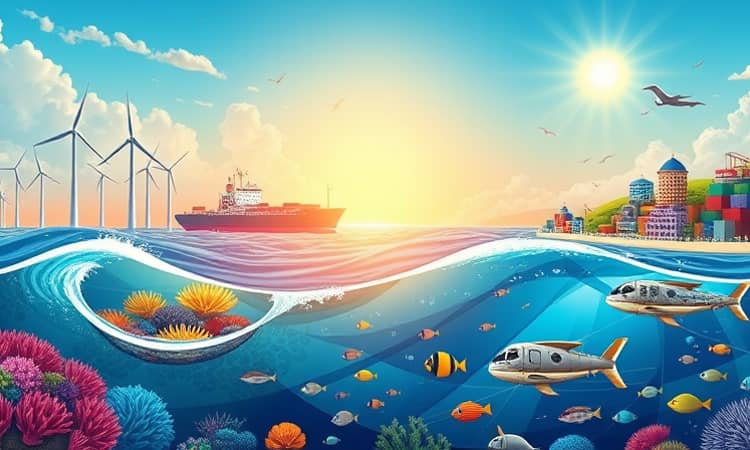
Our planet’s oceans cover more than 70 percent of the Earth’s surface, connecting societies, economies, and ecosystems in a vast blue network. The ocean economy represents not only a source of food and energy, but also a frontier for innovation, conservation, and inclusive growth.
By understanding its current size, potential challenges, and sustainable pathways forward, stakeholders—from individual investors to national governments—can work together to ensure the health and prosperity of our blue planet.
The Current Landscape of the Ocean Economy
Today, the global ocean economy is valued at nearly $2 trillion, with some estimates reaching $3 trillion depending on methodology. Since 1995, it has grown 2.5 times faster than overall global economic output, demonstrating its outsized influence on livelihoods, trade, and innovation.
Key statistics highlight this remarkable expansion:
- 2024 valuation: USD 1,958.52 billion
- Record 2023 exports: $2.2 trillion
- Projected $5 trillion by the early 2030s
- Coastal contributions doubling to $3 trillion by 2030
Supporting over 600 million jobs worldwide, the ocean economy underpins the daily lives of fishermen, port workers, marine engineers, scientists, and countless others. Its ripple effects touch agriculture, manufacturing, tourism, and technology sectors across the globe.
Sector Breakdown: Where Blue Growth Thrives
Beyond traditional fishing and shipping, the ocean economy now encompasses a diverse range of high-value activities. By reallocating capital into emerging sectors, we can catalyze sustainable ocean growth and drive further innovation.
As the fastest-growing segment, marine construction surged by 15.5 percent in 2023, driven by ports, coastal defenses, and offshore platforms. Meanwhile, services—from marine insurance to satellite monitoring—now account for nearly 59 percent of the total ocean economy.
Growth Drivers and Regional Leadership
The ocean economy’s expansion is driven by a confluence of technological, environmental, and demographic forces. Digital connectivity, automated fishing vessels, and underwater robotics are reshaping traditional practices, while climate resilience initiatives ensure communities adapt to rising seas.
- Energy transition and offshore renewables unlocking wind, wave, and tidal power
- Food security through sustainable aquaculture expansion
- Technological innovation in monitoring and exploration
- Climate resilience planning for coastal cities
On the global stage, the Asia-Pacific region leads in market share, propelled by rapid industrialization and maritime trade growth. Europe follows closely, pioneering sustainable ocean investments estimated at €124.5 million by 2030.
North America, Africa, and Latin America are accelerating development in blue biotechnology, marine tourism, and coastal infrastructure, creating a truly interconnected and dynamic economic network.
Challenges Imperiling Ocean Health
Despite its promise, the ocean economy faces stark threats that require immediate attention. Overfishing now affects nearly 38 percent of global fish stocks—almost quadruple the share in 1974—jeopardizing food security for billions.
Climate change compounds these risks. Seawater temperatures reached record highs in 2024, averaging 1.55°C above pre-industrial levels. Rising sea levels threaten ports, coastal settlements, and critical habitats.
- Two million tons of plastic enter the ocean annually
- Persistent chemical pollutants harm marine life
- Small island developing states face acute economic vulnerability
Funding gaps also hamper progress. Achieving Sustainable Development Goal 14 (“life below water”) demands $175 billion per year, yet only $30 billion has been disbursed since 2010. Meanwhile, $22 billion in harmful fishing subsidies continue to fuel overexploitation.
Strategies for Sustainable Investment and Action
To safeguard our blue planet, stakeholders must collaborate across sectors and geographies. Investors, policymakers, and local communities each play a vital role in shaping the future of the ocean economy.
Practical steps include:
- Redirecting subsidies towards marine conservation and sustainable fisheries
- Boosting research in ocean-based renewable energy and carbon sequestration
- Supporting local enterprises in coastal communities to build resilience
- Implementing transparent supply chains using digital tracking technologies
International alliances such as the Blue Tech Cluster Alliance unite clusters from ten countries, fostering innovation in marine biotechnology, clean energy, and sustainable seafood. Public-private partnerships can bridge the funding shortfall, unlocking investments that yield up to 615 percent returns over three decades.
By aligning financial incentives with conservation goals, we can preserve marine biodiversity for future generations while achieving robust economic growth.
Embracing a Blue Future
The ocean economy stands at a pivotal crossroads. We can continue on the path of exploitation and decline, or we can choose a different course—one that honors the intricate balance between prosperity and ecosystem health.
Individual actions—from supporting sustainable seafood to advocating for stronger marine protections—contribute to a collective wave of change. Companies can invest in green shipping, offshore renewables, and regenerative aquaculture. Governments can enact policies that reward conservation and penalize harmful practices.
As investors and citizens, our choices today will shape the blue planet our children inherit. By embracing innovation, collaboration, and stewardship, we can ensure that the ocean’s vast potential benefits all life on Earth.
Investing in our blue planet is not only an economic imperative but a moral one. Together, we can turn the tide toward a sustainable and flourishing ocean economy, securing a legacy of abundance, resilience, and wonder for generations to come.