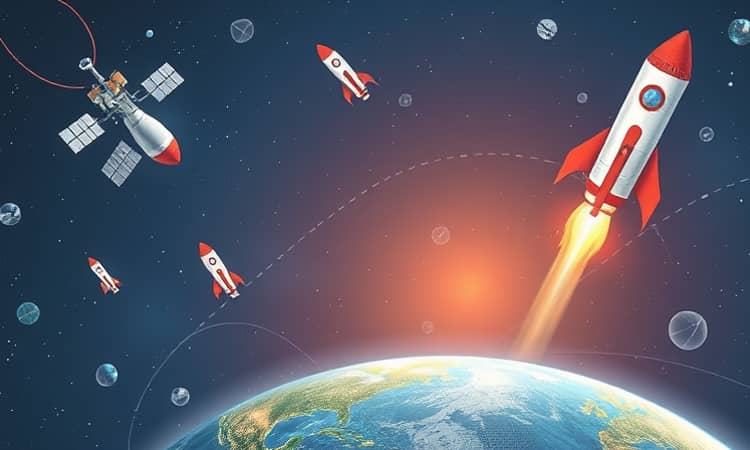
Imagine looking up at the night sky and seeing not just stars, but a thriving hub of economic activity. Once the exclusive domain of governments, space is now a dynamic marketplace where businesses are forging new paths. This shift from exploration to enterprise is unlocking possibilities that once seemed confined to science fiction.
With the global space economy reaching $470 billion in January 2026, commercial ventures are driving a monumental transformation. Gone are the days when space was solely about national pride; today, it's a fertile ground for innovation, investment, and growth that touches every aspect of our lives.
This new era is powered by falling launch costs and technological leaps, enabling entrepreneurs to dream bigger. From satellite broadband to lunar tourism, the opportunities are vast and growing, inviting everyone to be part of this celestial journey.
Market Size and Explosive Growth
The numbers tell a compelling story of rapid expansion. In just a few years, the space economy has surged from estimates like $630 billion in 2023 to projections that captivate the imagination.
Multiple studies highlight this upward trajectory. For instance, Grand View Research pegged it at $466.1 billion in 2024, with a compound annual growth rate (CAGR) of 9.3% pointing to $769.7 billion by 2030. Meanwhile, SNS Insider forecasts $447.90 billion in 2025, growing to $779.66 billion by 2033.
These figures are not just abstract; they reflect real-world momentum. The Space Foundation's comprehensive estimate of $613 billion in 2024 includes the full value chain, underscoring the depth of this market.
Looking ahead, the potential is staggering. Experts predict the space economy could reach $1 trillion by 2032 and soar to $1.8 trillion by 2035, adjusted for inflation. This growth is fueled by a convergence of factors that make space more accessible than ever.
- Government and private investments are surging, with $17 billion injected into 135 firms in Q4 2025 alone.
- Technological advances, such as reusable rockets, have slashed launch costs by 95% over the past decade.
- Demand for connectivity and data drives sectors like satellite broadband, which is growing at 30% annually.
To put this in perspective, the space economy is already rivaling other tech giants. It exceeds the cybersecurity market and is on par with cloud infrastructure, showing its maturity and promise.
Key Segments Driving Revenue
The commercial sector now accounts for 78% of total revenue, or $366 billion, demonstrating a shift from public to private dominance. This composition is diverse, with several high-impact segments leading the way.
Satellite services generated $108.3 billion in 2024, anchored by video broadcasting at $72 billion. However, the real star is broadband services, with Starlink alone reaching $8.2 billion in revenue and 9 million subscribers by December 2025.
Ground equipment, valued at $155.3 billion in 2024, includes everything from GPS receivers to satellite dishes. This segment supports everyday technologies, making space integral to modern life.
- Manufacturing and launch services are booming, with satellite manufacturing up 17% to $20 billion in 2024.
- Launch services grew 30% year-over-year to $9.3 billion, led by SpaceX's dominance in over 50% of global orbital launches.
- Government spending remains significant at $135 billion in 2024, with the U.S. contributing $79.7 billion to foster innovation.
Private investment has stabilized at $7.5 billion in 2024, but recent quarters show a resurgence, indicating renewed confidence. This ecosystem supports a global workforce of 1.5 to 2 million people, with average revenue per employee typical of high-tech industries.
Commercial Opportunities and Applications
The practical applications of space technology are vast, offering tangible benefits for businesses and individuals alike. This isn't just about rockets; it's about creating value on Earth and beyond.
Satellite communications have become a cornerstone. Low Earth orbit (LEO) broadband constellations, commercially viable only since 2020-2021, are revolutionizing connectivity. Starlink's rapid subscriber growth demonstrates insatiable market demand for global internet access.
Earth observation and navigation services, estimated at $30 billion, empower industries from agriculture to logistics. For example, companies like Uber rely on GPS for seamless driver-rider connections, showing how space tech integrates into daily life.
- Space tourism is emerging as a niche but growing segment, attracting adventurous consumers.
- Lunar and interplanetary exploration are listed as key growth drivers for 2026, opening frontiers for resource mining and scientific research.
- Broadband services show 30% annual growth, highlighting the shift towards digital dependency.
These opportunities are not limited to large corporations. Startups and investors can tap into areas like small satellite manufacturing or data analytics, leveraging the democratization of space access.
Industry Structure and Global Impact
The space economy is a mosaic of players, from giants like SpaceX to nimble startups. SpaceX dominates the commercial launch market with over 50% share, yet it represents only about 3% of the total $470 billion market.
This implies a vast ecosystem of thousands of companies, each contributing to innovation. In Q4 2025 alone, 135 space firms received investments, showcasing a vibrant and competitive landscape.
Public-private partnerships are transforming the industry, blending government oversight with entrepreneurial agility. This collaboration accelerates projects like lunar missions or climate monitoring satellites.
- Geographically, North America holds 46.02% of the market share, led by the U.S. space economy projected to grow from $128.28 billion in 2025 to $208.59 billion by 2033.
- Asia Pacific is the fastest-growing region, driven by technological adoption and investment.
- Europe remains strong, with the European Space Agency budgeting €7.68 billion for 2025.
The economic ripple effects are profound. Beyond direct employment, space technology enables industries worldwide, from finance to healthcare, through enhanced data and connectivity.
Historical Context and Future Projections
Space commercialization isn't new; it began over 60 years ago with the first satellites. However, the pace has accelerated dramatically in recent decades, moving beyond pioneering phases into sustained growth.
Launch costs have fallen 95% over the past decade, a game-changer that has enabled business models once deemed impossible. This reduction mirrors the evolution of other tech sectors, positioning space as a mature yet dynamic market.
Looking to the future, long-term projections are awe-inspiring. The global space economy may grow to $2 trillion by 2040, according to some estimates. World Economic Forum and McKinsey project $1.8 trillion by 2035, accounting for inflation and broader applications.
- Growth drivers include sovereign autonomy requirements, as nations seek independent space capabilities.
- Digital transformation across industries fuels demand for space-based infrastructure.
- Technological advances in satellite operations, such as AI integration, promise even greater efficiency.
These projections are supported by robust methodology, considering both "backbone" applications like satellites and "reach" applications that extend space tech into consumer markets. Broader definitions, including GPS-enabled services, can push estimates to $700 billion or more.
Practical Steps for Engagement
For those inspired to join this frontier, the path is clearer than ever. Whether you're an investor, entrepreneur, or enthusiast, there are ways to contribute and benefit from the space economy.
Start by educating yourself on key trends. Follow developments in satellite broadband or earth observation, as these areas offer immediate opportunities. Networking with industry groups can provide insights and partnerships.
Consider investment avenues, from publicly traded space stocks to venture capital in startups. The stabilization of private investment at $7.5 billion in 2024, with recent spikes, indicates a healthy market for funding.
- Explore careers in high-demand fields like aerospace engineering, data science, or regulatory affairs.
- Leverage space data for business applications, such as using satellite imagery for agriculture or logistics optimization.
- Advocate for policies that support innovation, ensuring a sustainable and inclusive growth trajectory.
Remember, this isn't just about profit; it's about pioneering a future where space enhances life on Earth. From tackling climate change with satellite monitoring to connecting remote communities, the societal benefits are immense.
As we stand on the brink of a trillion-dollar industry, the message is clear: the stars are within reach. Embrace the curiosity that drives exploration, and let it fuel your journey into this new economic frontier. Together, we can build a legacy that transcends our planet, proving that the final frontier is not just a destination, but a home for human ingenuity.