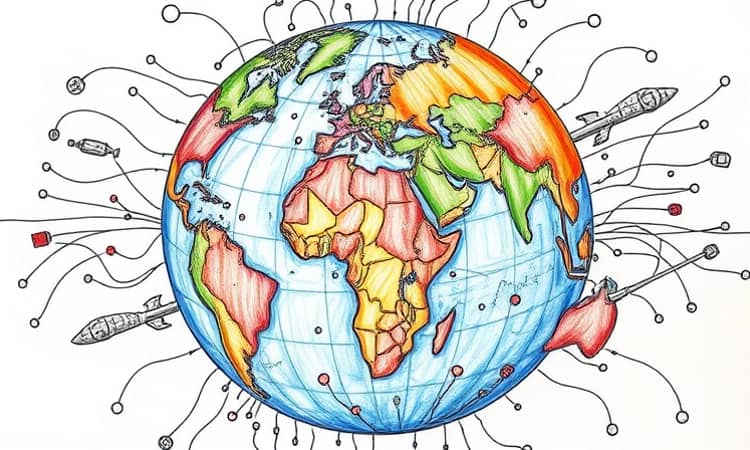
In an era marked by boundless connectivity, global commerce resembles a grand tapestry where each thread represents a nation, an industry, or a vital resource. We live in a reality shaped by interconnected global supply chains, offering remarkable efficiency but also exposing every corner of the world to shared vulnerabilities. As disruptions from tariffs, geopolitics, or climate events ripple outward, nations, companies, and individuals must find ways to adapt and thrive.
Trade Growth and Future Projections
After a robust 4.2% year-over-year rise in global trade volume for FY2025, growth began to temper in the latter quarters. Early frontloading gave way to slowing momentum, as rising tariffs and protectionist measures cast long shadows over cross-border exchanges. Forecasts for 2026 suggest further flattening, reflecting a world at a crossroads between cooperation and fragmentation.
These projections underscore the need for businesses and policymakers to anticipate shifts and prepare proactive responses:
- OECD expects global GDP growth of 2.9% in 2025–2026, down from 3.3%.
- The UN projects a decline from 2.8% in 2025 to 2.7% in 2026.
- The World Bank foresees 2.6% growth amid waning inventory restocking.
- The IMF predicts a modest rebound to 3.3% in 2026.
As the United States accounts for 14% of global imports and sees its goods/services deficit climb, rapid intra-Asia trade emerges as a beacon of dynamism amid rising fragmentation.
China Dependency and Diversification Efforts
China’s record $1.2 trillion trade surplus in 2025 highlights its central role, even as U.S. exports to China wane. By channeling goods to Europe, Latin America, and neighboring Asian economies, Beijing navigates global pressures while reinforcing its manufacturing stranglehold. Initiatives like the EU Critical Raw Materials Act and U.S. tariffs aim to curb dependence, yet relocation frequently stays within Asia, reflecting China’s dominant processing capacity and unrivaled scale.
Critical minerals paint a stark picture of this reliance:
- China controls nearly 78% of cobalt processing.
- It commands almost all rare earth element production and processing.
- New export controls on rare earth magnets and processing tech took effect in October 2025.
These concentrations empower China to weaponize economic levers, reminding partners that true diversification demands strategic foresight and investment beyond simple relocation.
Supply Chain Vulnerabilities and Costs
Even as global supply chain losses fell to $184 billion in 2025—an 88% reduction from peak stress—disruptions can still shave nearly 8% off annual revenues. With a 27% chance of a severe interruption every 3.7 years and an average recovery period of two to three years, firms confront persistent risk.
Climate shocks became commonplace, affecting 63% of companies in 2025. In response, 78% adopted inventory buffers and supplier diversification, while 82% grappled with new tariffs that impacted 20–40% of their activities. For U.S.-connected chains, 70% reported equal or greater demand challenges at home and abroad, illustrating how vulnerabilities to disruptions like tariffs can cascade through networks of producers and consumers.
Building Resilience: Strategies for Adaptation
Leading organizations are reshaping their operations with diversified multi-shoring strategies for resilience. By 2025, half of companies had embraced multi-shoring, boosting reliability by an average of 10%. In Asia alone, 40% of firms recaptured 2% in margins through smart supplier diversification.
- Digital platforms and AI-enabled forecasting optimize inventory levels.
- Robust supplier scorecards enforce rigorous risk assessments.
- Strategic stockpiles of critical minerals mitigate extraction or export controls.
- Cross-sector partnerships accelerate shared logistics and contingency planning.
Meanwhile, U.S. reshoring efforts gather pace in select sectors—automotive, pharmaceuticals, agriculture—yet high costs and regulatory hurdles persist. Policymakers can support these moves through targeted incentives and enhanced infrastructure funding.
Geopolitical and Regional Dynamics
With the U.S.-China trade deal set to expire and USMCA under review in 2026, geopolitical undercurrents deepen uncertainty. Conflicts in Ukraine and the Middle East erode confidence, while the Eurozone grapples with high energy costs that stifle exports. Across emerging markets, some nations benefit from supply chain realignments, even as high tariffs in China and India pose barriers.
In the race for critical minerals, the Democratic Republic of the Congo supplies over 70% of the world’s cobalt, elevating coercion risks. As energy importers shift from traditional sources, renewable supply chains—solar panels, battery packs—offer more stable alternatives to hydrocarbons.
Navigating a Fragmented Future
Since the 1990s, globalization’s promise of specialization and scale fueled unprecedented growth. Yet today, under the microscope of trade frictions, climate challenges, and skyrocketing debt, that same interdependence spawns anxiety. Tools like the World Bank’s GSCSI remind us of the clockwork precision needed to keep container networks humming, while the WEF’s Global Value Chains Outlook 2026 advocates collaboration between governments and corporations.
Ultimately, the path forward demands creative problem-solving, investment in digital and human capital, and unwavering commitment to adaptability. By embracing diversified partnerships across regions and fortifying supply chain agility, businesses and nations can transform vulnerability into a source of strength.
In this intertwined world, every stakeholder—from factory floor managers to policy architects—can contribute to a more resilient, equitable, and prosperous global economy. The journey starts with foresight, collaboration, and the courage to rethink long-standing assumptions.