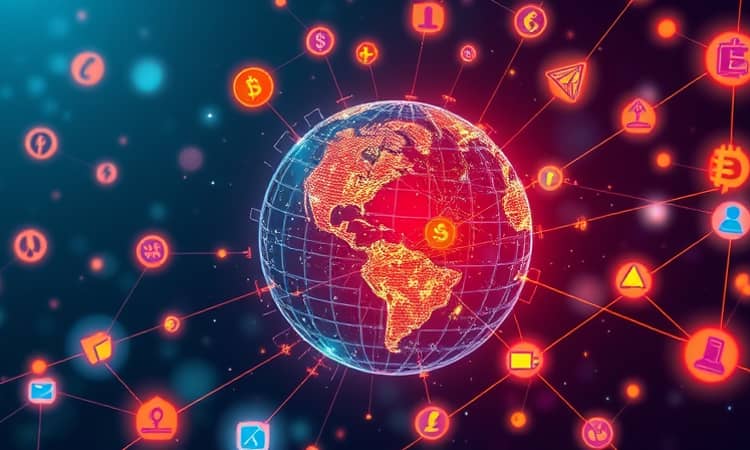
Imagine a world where money, assets, and intellectual property move as freely as emails, instantly and without cumbersome fees or opaque barriers. This vision is the Internet of Value (IoV).
Definition and Core Concept
The Internet of Value is an evolution of the internet that enables value exchange in real time between any parties. Unlike the Internet of Things, which connects devices, IoV focuses on transferring tangible and intangible assets.
By leveraging blockchain and distributed ledger technology, IoV creates a global, decentralized network where transactions are validated, permanent, and transparent. This new paradigm minimizes or eliminates traditional intermediaries—banks, clearinghouses, credit card companies—reducing delays and costs.
Historical Evolution and Origins
The seeds of IoV were sown over decades of technological progress: from mainframes to personal computers, the rise of the internet, the explosion of social media, and the advent of smartphones and cloud computing.
The 2008 financial crisis exposed vulnerabilities in centralized banking and inspired Satoshi Nakamoto’s Bitcoin whitepaper, proposing a peer-to-peer electronic cash system. This breakthrough laid the groundwork for a broader ecosystem.
By 2012, Ripple (initially OpenCoin) advanced these ideas, integrating the XRP Ledger and the concept of the Interledger Protocol. Innovators like Arthur Britto, Jed McCaleb, and David Schwartz popularized the term “Internet of Value,” comparing blockchain to the second major overlay on the internet, second only to the World Wide Web.
Key Technologies Enabling IoV
These technologies enable decentralization mechanics across networks, where nodes verify balances and prevent double-spending. Smart contracts code conditional value transfers—imagine a Mumbai property buyer automatically receiving 5% of New York rental income.
Current Problems with Legacy Systems
Traditional financial infrastructure grapples with latency, high fees, and limited access.
- Cross-border payments can take 3–5 days, incur over 5% error rates, and cost upwards of $40 per transfer.
- Opaque centralized processes erode trust, highlighted by post-2008 banking scandals.
- Nearly 1.4 billion people remain unbanked, excluded from global commerce.
Global cross-border flows totaled $180 trillion in 2021, with an annual cost exceeding $1.7 trillion. A minor fraction of crypto activity (<1%) fund illicit uses, showcasing the ecosystem’s maturity and transparency gains.
Real-World Applications and Examples
IoV is no longer theoretical—it’s already reshaping industries.
- Finance: Nasdaq uses blockchain for share tracking; Peach Aviation accepts cryptocurrency for flight bookings.
- Healthcare: Estonia secures millions of patient records on distributed ledgers.
- Entertainment: Artists like Imogen Heap distribute music directly to fans, removing labels as middlemen.
- DeFi: Decentralized lending, staking, and yield farming offer transparent financial services without gatekeepers.
Beyond finance, property titles, art ownership, votes, and loyalty points can be tokenized and freely traded. IoV envisions a world where unique assets are instantly liquid and accessible.
Benefits and Transformative Impacts
The advent of IoV promises profound changes:
- Instant, low-cost global transfers replacing slow, expensive wires.
- Financial inclusion for underserved communities, empowering entrepreneurs in emerging markets.
- Immutable transparency and accountability via public ledgers.
- New business models: tokenized real estate, community-owned ventures, programmable revenue streams.
Economists liken IoV’s disruptive power to container shipping in the 1950s or web protocols in the 1980s. It rebuilds trust, unleashes innovation, and inaugurates a true peer-to-peer commerce era.
Challenges and Future Outlook
Despite remarkable advances, significant hurdles remain:
Interoperability across disparate networks demands unified protocols like ILP. Regulatory clarity must evolve to foster mainstream adoption without stifling innovation. Industry collaboration on reserve reporting and anti-illicit frameworks will bolster confidence.
As web3 matures, IoV’s potential extends beyond finance to knowledge exchange, intellectual property markets, and global voting systems. An inclusive digital economy could reshape geopolitical power dynamics, reduce inequality, and spark unprecedented cooperation.
The journey from Bitcoin’s genesis block in 2009 to a full-fledged Internet of Value is far from over. Yet every new protocol, every enterprise pilot, and every real-world use case brings us closer to a world where value flows as freely as information.
Embracing IoV means joining a movement that unites technology, finance, and human aspiration to create an inclusive, transparent, and borderless economy. The future belongs to those who build and trust in a truly connected network of value.