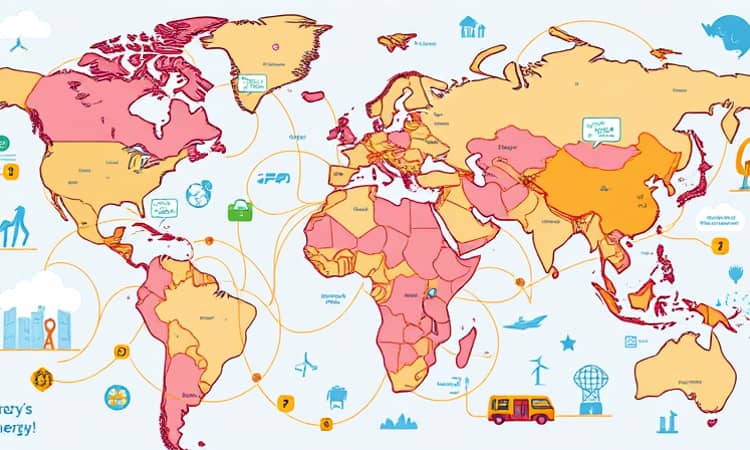
As we navigate the unfolding tapestry of 2026, global markets reveal a mosaic of challenges and opportunities. Understanding these shifts is essential for staying ahead in an ever-evolving environment.
Global Economic Overview for 2026
In early 2026, economies around the world are contending with a blend of subdued growth and regional divergence. The International Monetary Fund projects global GDP rising 2.6% to 2.7%, reflecting uneven momentum among advanced and developing nations. While emerging markets excluding China aim for roughly 4.2% expansion, powerhouse economies like the United States, China and the European Union face waning momentum.
Trade growth has likewise slowed amid rising fragmentation, with services exports now comprising 27% of global trade and growing near 9% in 2025. South-South merchandise exchanges surged to $6.8 trillion, up from a mere $0.5 trillion in 1995, highlighting shifts toward regional partners.
Key Projections and Numbers
Critical metrics define the year ahead:
Inflation and cost pressures persist: In the United States, residential electricity prices climb 4.2% and medical care costs jump 8.5% in 2026, keeping core inflation sticky.
Meanwhile, dynamic sectors strain resources in unexpected ways.
Commodities and Projections
Several key commodities play pivotal roles in fueling transitions across sectors and geographies.
These figures illustrate how the energy transition and green technology demand converge with digital expansion to create novel strains on infrastructure.
Major Trends and Drivers
The global web of commerce in 2026 is being rewoven by several interconnected forces:
- Regional supply chain resilience through nearshoring reduces reliance on distant producers.
- Digital trade and AI driven services redefine cross-border exchanges.
- Sustainability imperatives fueling green trade practices and carbon compliance.
- Geopolitical realignments forming new trade blocs like RCEP and CPTPP.
- Innovations in trade finance and digital currencies streamline transactions.
Organizations are diversifying suppliers and relocating production closer to home markets, while embracing blockchain for transparent, secure logistics.
Risks and Challenges Ahead
Despite clear avenues for growth, several headwinds threaten progress:
- Rising tariffs and policy uncertainty disrupt long-standing supply networks.
- Grid shortfalls and commodity deficits inflate operational costs.
- Slower overall growth constrains infrastructure and industrial investment.
Smaller economies, in particular, may find themselves squeezed between powerful trading blocs and shifting regulatory regimes.
Opportunities for Resilience and Growth
In the face of these risks, proactive strategies can yield lasting benefits:
- Strengthening South-South partnerships to diversify markets and build stability.
- Investing in digital infrastructure to bridge divides and empower SMEs.
- Adopting circular economy principles and green standards to attract investment.
By aligning policy frameworks with industry innovation, stakeholders can create virtuous cycles of efficiency and sustainability.
Strategic Takeaways for Businesses and Policymakers
As 2026 unfolds, decision makers must consider several critical imperatives:
Integrate industrial strategy with digital regulation to foster adaptive, secure ecosystems. Embrace workforce development and immigration policies to alleviate labor bottlenecks, especially in high-tech and logistics sectors. Coordinate carbon border frameworks and green financing to maintain competitiveness in global markets.
At the international level, a successful WTO ministerial in 2026 can harmonize dispute resolution and rulemaking, countering unilateral measures and fostering trust.
Building a Resilient Future
The global market dynamics of 2026 reveal a complex tapestry woven from regional cooperation, technological innovation, sustainability imperatives, and geopolitical currents. Viewing these elements as interconnected rather than isolated challenges enables stakeholders to craft strategies that are both robust and forward-looking.
By leveraging interconnected forces shaping global markets—from AI-driven forecasting in logistics to carbon-aware shipping and diversified trade finance—business leaders, governments and communities can navigate uncertainty and unlock shared prosperity.
Ultimately, resilience and adaptability, supported by thoughtful policy and bold investment, will define the next chapter of global commerce.