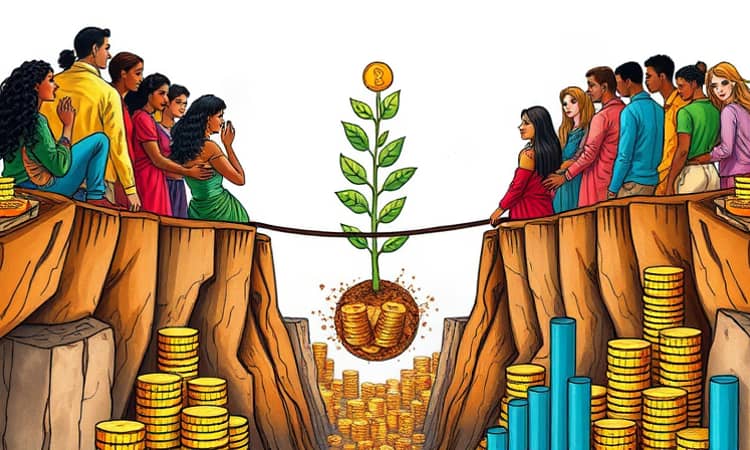
Across the world, an astonishing concentration of resources leaves billions struggling to catch up. While the top 10% of adults receive more than half of global income and own three quarters of all wealth, the bottom 50% share a mere fraction. These imbalances shape life chances, political power, and environmental outcomes. Yet, within this daunting reality lies an opportunity: purposeful investment strategies can tilt the scales toward long-term sustainable growth and inclusive prosperity.
By examining the core drivers of inequality and deploying capital with intention, investors can become agents of change. This article unpacks the statistics behind the divide, explores its systemic impacts, and lays out actionable pathways—from Wealthtech innovations to policy reforms—to narrow the gap.
Understanding the Global Wealth Divide
Recent data reveals that 560 million adults in the top 10% receive 53% of global income, while 2.8 billion adults in the bottom half capture only 8%. Wealth concentration is even starker: the richest 1% own 37% of all assets and the top 0.001% average fortunes exceeding €1 billion per person. Regional disparities multiply the challenge, with North America and Oceania boasting average wealth over 16 times that of Sub-Saharan Africa.
Over the past three decades, wealth inequality has grown faster than income inequality. The bottom 50% saw their assets grow at 3.4% annually since 1995, but the top 0.001% outpaced that continuously, tripling their share relative to the bottom half. Today, the global income Gini coefficient stands at 0.61, and over 80% of countries exhibit high inequality levels.
This widening divide stems from historic policy choices, technological change, and financial innovations that disproportionately benefit those with existing capital. Without targeted interventions, these trends threaten economic mobility, social cohesion, and global stability.
Systemic Impacts of Extreme Inequality
Beyond raw numbers, the wealth gap drives a cascade of societal risks. When power and resources cluster at the top, democratic processes erode, and pressing issues like climate change and food security worsen for the vulnerable.
- Climate Inequality: The wealthiest 10% generate over 75% of emissions from private capital, while the poorest bear the brunt of environmental shocks.
- Democratic Threats: Billionaires are thousands of times more likely to influence policy, skewing governance away from the majority’s interests.
- Food and Health Risks: 2.6 billion people cannot afford a healthy diet, even as the richest billionaires grow richer by the year.
- Racial and Gender Gaps: Income and wealth disparities persist across gender and ethnic lines, compounding social injustice worldwide.
Unchecked, these forces undermine economic growth, hinder social mobility, and polarize societies. Addressing them demands both capital deployment and structural reforms to ensure that the benefits of finance extend beyond the privileged few.
Investment Strategies for Equitable Growth
Fortunately, recent innovations in finance unlock new avenues for inclusive wealth building. Tools that once catered exclusively to institutions are now within reach of everyday investors, creating a platform for change.
- Wealthtech Democratization: Low-cost ETFs, fractional shares, and commission-free trading bring equitable access to capital and financial markets to millions.
- Systemic Stewardship: The TIIP framework guides investors to tackle systemic inequality through investments, from labor rights engagement to tax policy advocacy.
- Inclusive Investing: Prioritize strategies that build ownership for underserved communities, closing racial and gender wealth gaps.
- Impact Accountability: Develop clear metrics and reporting to monitor social and environmental outcomes alongside financial returns.
- Market Innovations: Rethink money as a vehicle for shared prosperity by promoting ownership and long-term engagement.
By combining these approaches, investors can generate returns while actively reducing the wealth divide. Education and transparent reporting ensure that first-generation investors harness compound interest to secure economic resilience.
Policy Measures to Complement Investment
Investment alone cannot solve systemic inequality. Public policy must reinforce market solutions with robust regulations and fiscal reforms designed to redistribute excess gains and close loopholes.
Additional measures include ending tax havens, reforming upside-down tax expenditures, and enforcing stricter campaign finance laws. Investments in quality jobs, universal healthcare, and education strengthen the foundation for equal opportunity and social mobility.
Together, these policies and investment strategies form a powerful toolkit. When governments and markets align, they can deliver both growth and fairness, fostering environments where every individual has the chance to thrive.
Building a Path Forward
The global wealth divide is neither inevitable nor insurmountable. Through a blend of democratization of financial markets, targeted stewardship, and smart public policy, we can chart a path toward a fairer world. Each dollar invested with intention becomes a step toward shared prosperity, transforming systems that have long favored the few.
Investors, policymakers, and citizens must collaborate to ensure capital serves humanity’s highest ideals. By prioritizing equity, transparency, and impact, we can rewrite the narrative of finance and build an economy that works for everyone.
In this pivotal moment, we hold the tools to close the divide. The choice before us is clear: continue down a trajectory of concentration and exclusion, or harness our collective power to create a more inclusive future. The time to act is now.