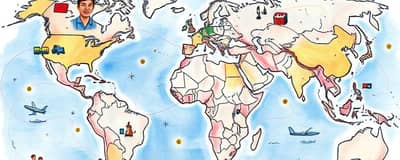
In today's interconnected world, embracing the role of a global citizen investor opens doors to unparalleled financial growth and diversification.
With global economic output projected to grow steadily, the landscape is ripe for those who dare to look beyond their borders.
This guide delves into the comprehensive insights and practical strategies needed to navigate this dynamic terrain successfully.
Navigating the Global Economic Landscape
Understanding the broader economic context is crucial for making informed investment decisions.
Global growth is forecast at 2.7% in 2026, showing resilience despite slight deceleration.
Regional variations highlight where opportunities might be concentrated.
- Emerging markets and developing economies continue to outperform advanced economies.
- South Asia leads with 5.6% growth, driven by India's robust expansion.
- Africa projects a 4.0% increase, bolstered by rising exports to developing markets.
- The Eurozone expects 0.9% growth, supported by public investment initiatives.
These trends underscore the importance of geographic diversification in your portfolio.
The Shifting Tides of Global Trade
Trade dynamics are evolving, with significant implications for cross-border investments.
Global trade reached a record $35 trillion in 2025, but growth is expected to slow to 2.2% in 2026.
Services trade is a standout performer, now accounting for 27% of global exchanges.
This surge is driven by digitally deliverable services, which grew by about 9% last year.
- Nearly two-thirds of global trade occurs within value chains.
- South-South trade has become a major engine, rising from $0.5 trillion to $6.8 trillion since 1995.
- Over half of developing-country exports now go to other developing economies.
These shifts highlight new corridors for investment and trade partnerships.
South-South Trade: A New Engine of Growth
The rise of trade between developing countries is reshaping global economics.
South-South merchandise exports have surged dramatically, driven by Asia's regional value chains.
More than half of Africa's exports now flow to developing markets, indicating a pivot away from traditional hubs.
- High and medium-tech manufacturing in East and Southeast Asia dominates this growth.
- As demand weakens in advanced economies, South-South trade is likely to expand further.
Investors can capitalize on this by targeting regions with strong intra-developing trade links.
Reconfiguring Value Chains for Resilience
Value chain reconfiguration is creating new hubs and routes, offering both challenges and opportunities.
While diversification enhances resilience, it may reduce efficiency and weigh on trade growth.
Resource security remains a critical issue, with mining investment growth slowing and export controls tightening.
- Financing focuses on near-mine projects, limiting new greenfield development.
- Export controls in regions like the Democratic Republic of the Congo and China affect supply chains.
Strategic investments in secure resource sectors can mitigate these risks.
Trends in Cross-Border Capital Flows
Capital flows have increased since 2022, reflecting growing investor confidence in global markets.
The U.S. net international investment position was –$27.61 trillion in Q3 2025, with assets rising to $41.27 trillion.
Global investment growth remains subdued due to geopolitical tensions and tight fiscal conditions.
- Monetary easing and fiscal measures support investment in some economies.
- Rapid AI advances fuel capital spending in large markets.
Staying attuned to these flows can help identify timing for entry and exit points.
Spotlight on Regional Investment Hotspots
Specific regions offer targeted opportunities for savvy investors.
Emerging markets have generated strong investment performance across asset classes, supported by improved frameworks.
Argentina's Large Investment Incentive Regime guarantees stability for projects over $200 million.
Canada is reducing regulatory hurdles to spur investment and diversify exports.
- Mexico expects GDP growth of 1.6% in 2026, with nearshoring boosting manufacturing.
- New Zealand can attract foreign investment by promoting stability and safety.
- The Eurozone benefits from EU-level initiatives like the NextGen EU funds.
Each region presents unique advantages based on policy and economic conditions.
Infrastructure and Technology: The AI Revolution
The AI boom is transforming real estate and infrastructure, creating new asset classes.
Data centers are emerging at the intersection of infrastructure, energy, and land use.
Demand for power and data is accelerating, driven by AI advancements.
- Labor shortages in Japan and the U.S. impact data center developments.
- Immigration policies affect labor supply, necessitating strategic planning.
Investing in tech-driven infrastructure can yield long-term returns.
Policy Frameworks and Trade Agreements
Trade agreements shape the investment landscape by reducing barriers and creating stability.
The MERCOSUR-EU deal aims to establish the largest free trade zone globally, ratified by most EU states.
The USMCA's six-year review in 2026 will influence North American trade dynamics.
These frameworks provide predictable environments for cross-border investments.
Asset Performance: Where to Allocate Capital
Equity markets show promising trends for 2026, with broadening opportunities.
Emerging market equities have turned a corner, showing strong performance after lagging years.
European equities and US smaller-cap stocks are also poised for growth.
- Overseas investors remain keen on European logistics assets.
- The path for U.S. equity markets is higher, driven by margin expansion.
Diversifying across these asset classes can enhance portfolio resilience.
Managing Risks in a Complex World
Geopolitical tensions and protectionism pose significant risks to growth and trade.
Rising protectionism is redefining trade flows with new risks and opportunities.
AI gains may be unevenly distributed, risking wider structural inequalities.
- Countries with strong infrastructure and stable policies are better positioned.
- Peripheral economies risk sidelining unless they upgrade skills and logistics.
Proactive risk management is essential for sustainable investment success.
Practical Steps for the Aspiring Global Investor
Start by conducting thorough research on target regions and sectors.
Diversify across geographies and asset classes to mitigate risks.
Leverage trade agreements and policy incentives for favorable terms.
Monitor global economic indicators and adjust strategies accordingly.
Engage with local experts to navigate cultural and regulatory nuances.
By embracing these steps, you can harness the full potential of cross-border investments.