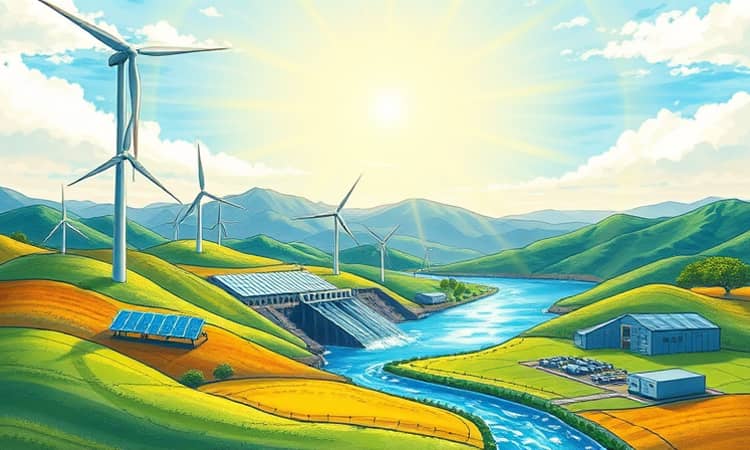
In an era defined by unprecedented technological advancement and mounting environmental urgency, our global energy paradigm is shifting. The surging demand from AI, data centers, and digital infrastructure has propelled electricity needs to record highs, revealing the critical necessity for sustainable power solutions. This exploration charts the innovative strategies, remarkable achievements, and persistent obstacles on the path to a clean energy future.
Rapid Growth in Renewable Capacity and Investment
Between 2025 and 2026, renewables accounted for 93% of new capacity additions in the United States, adding over 30 GW through September 2025. Solar and storage dominated with 83% of these deployments. Globally, sustainable energy investment surpassed $2.3 trillion in 2025—an 8% uptick from 2024—reflecting a collective commitment to clean power.
Utility-scale projects reached a two-decade high, with the US installing 54 GW of generation and storage. Onshore wind capacity expanded 30% year-over-year, and battery storage operating capacity climbed 32% to 37.4 GW. By 2025, renewables captured 26% of US electricity generation, and zero-emission sources collectively hit 43%, underscoring a momentous shift toward renewables.
Hyperscale tech companies contracted 78% of their energy from renewables, with nuclear and hydro covering the balance. These data center giants represent 90% of global carbon-free offtake contracts, driving demand for firm, low-carbon power and stimulating paired storage and baseload innovations.
Global Energy Investment and Deployment
Renewables generated one-third of global electricity in 2024 yet fulfilled only 8% of total energy demand. Since 2010, clean sources have avoided 1,371 EJ of fossil fuel use, equating to 2.5 times 2024’s global energy supply and preventing 109–110 gigatons of greenhouse gas emissions—170% of 2024 emissions.
Grid capital expenditures reached a record $115 billion in 2025, a 9.5% increase. Efficiency gains surged 7% globally, demonstrating that renewables deliver more work per unit of input compared to fossil-based systems.
Policy Shifts and Supply Chain Dynamics
Policy frameworks have steered investment and deployment. In the US, 28 states with renewable portfolio standards drove 37% of capacity additions. Conversely, some regions rolled back targets, such as Ohio’s sunsetting RPS post-2026 and North Carolina’s revised 2030 goal, illustrating the fragility of policy certainty.
- Safe-harbor strategies securing production tax credits
- FEOC rules targeting equipment linked to sanctioned nations
- Tariffs inflating solar and wind component costs by 36–63%
In the first nine months of 2025, corporate deal value declined 41% to $6 billion, yet platform acquisitions surged 4.6-fold, signaling strategic consolidation in a dynamic project pipeline. Safe-harbor projects now represent 38% of the 58.4 GW transacted pipeline, underscoring industry ingenuity in navigating policy deadlines.
Regional Leadership and Differing Dependence on Fossils
China leads with an $800 billion investment—4.1% of GDP—and contributed 60% of global renewable additions in 2024. India’s policies foster domestic manufacturing and storage scale-up, with the Dhirubhai Energy Complex launching gigafactories for solar modules, batteries, and electrolyzers in 2026.
Europe and North America avoided 21% and 20% of fossil use in 2024, respectively. Offshore wind pipelines in states like New York and California have tripled, while hybrid projects blend renewables with gas for balanced output, reflecting balanced energy portfolios that bolster security.
Technological Bridges for 24/7 Clean Power
Intermittency remains a key challenge. Battery storage, flexible hydroelectric systems, and geothermal baseload capacity are essential for consistent clean energy delivery. The US anticipates 187 GW of storage by 2030, with over half paired with solar in the Southwest.
Long-duration storage solutions, such as pumped hydro and emerging hydrogen storage, promise to extend renewable reliability across daily and seasonal cycles. Cross-border R&D collaborations are accelerating these innovative grid solutions, ensuring clean energy flows day and night.
Challenges and Cost Impacts
Barriers persist despite record installations:
- Interconnection queue backlogs delaying approvals
- Permitting complexity fueled by local opposition
- Rising equipment costs due to tariffs and supply constraints
Only 35% of the global renewable pipeline is under construction, highlighting regulatory and workforce bottlenecks. Without streamlined processes and expanded training, project timelines risk slipping, delaying crucial capacity needed to satisfy soaring demand.
Future Outlook: Execution and Innovation through 2030
Looking ahead, stakeholders must emphasize practical execution. Key priorities include:
- Front-loading construction to secure tax credits
- Diversifying supply chains to reduce geopolitical risks
- Leveraging AI and digital tools for enhanced efficiency
- Building workforce capacity in clean energy sectors
Annual additions of solar, wind, and storage are projected at 30–66 GW in the US from 2026 to 2030—a slight reduction from earlier forecasts but still transformative. Competitive dynamics will intensify as nations vie for leadership in batteries, green hydrogen, and AI-driven grid services. Strategic partnerships between governments, private sector, and research institutions will be crucial for unlocking next-generation innovations that scale rapidly and cost-effectively.
The choices we make today will shape an energy landscape that is abundant, equitable, and sustainable. By embracing collaboration, innovation, and determined execution, we can accelerate the transition to renewables and secure a resilient energy future for generations to come.
Together, we can champion the clean energy revolution, forging a world powered by renewable resources, where progress and stewardship go hand in hand.