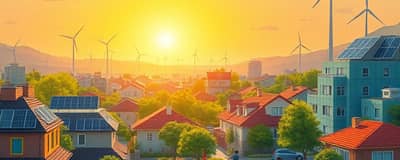
As we step into 2026, the green economy is no longer a niche concept but a global force, driven by soaring commercial momentum and relentless innovation that defies political challenges.
With an annual value exceeding $5 trillion, this sector is reshaping industries and offering unprecedented investment avenues for forward-thinkers who prioritize both profit and planet.
The energy transition is accelerating at a breathtaking pace, with renewables now outpacing global energy demand growth, signaling a fundamental shift in how we power our world.
The Unstoppable Rise of Renewable Energy
Renewable sources like solar and wind are leading the charge, adding immense capacity each year.
In recent data, solar alone contributed 621 terawatt-hours in just three quarters, surpassing total energy demand growth.
This surge is fueled by massive investments in storage and grid infrastructure, making clean energy more reliable than ever.
- Solar and wind investments are driving down costs and increasing accessibility.
- Energy storage solutions, such as batteries, are crucial for managing intermittent supply.
- Grid modernization ensures efficient distribution of renewable power across regions.
Fossil fuel generation is contracting, highlighting the irreversible shift towards sustainable alternatives that promise long-term stability.
Building Resilience Through Climate Adaptation
Beyond mitigation, the focus is shifting to adaptation, with businesses and governments investing in resilience.
Over one-third of large corporations now incorporate adaptation plans, addressing risks from floods to droughts.
This trend is supported by innovative technologies in water management and agricultural resilience.
- Water tech innovations help communities cope with scarcity and pollution.
- AI-driven analytics improve predictions for natural disasters like fires and floods.
- Public-private partnerships fund infrastructure projects that enhance climate defenses.
Adaptation spending, though below $100 billion annually, is growing as resilience becomes a core growth driver in volatile climates.
Sustainable Finance: The New Frontier
Green bonds and other financial instruments are evolving to support broader environmental goals.
Biodiversity-linked bonds, for instance, have surged from 5% to 16% of green issuances in just three years.
Blue bonds and debt-for-nature swaps, like Ecuador's $1.6 billion deal, are gaining traction.
This maturation of sustainable finance offers diverse entry points for impact investing that align with global sustainability targets.
AI and Technology as Catalysts for Change
Artificial intelligence is both a driver and enabler of the green economy, demanding energy while optimizing systems.
Data centers, powered by renewables, are fueling growth in regions like the US and Europe.
AI enhances risk modeling and geospatial analytics, making adaptation efforts more precise and effective.
- AI improves efficiency in renewable energy forecasting and grid management.
- Agri-tech innovations boost food security through resilient farming practices.
- Circular economy models leverage tech to reduce waste and resource consumption.
However, this integration comes with risks, such as sustainability data challenges, requiring careful balancing of innovation and oversight.
Regional Dynamics: Asia Takes the Lead
Asia has emerged as the epicenter of green economic activity, with China dominating clean energy manufacturing.
China's clean tech exports hit a record $20 billion in a single month, showcasing its supply chain strength.
India and ASEAN nations are pivotal swing factors, driving policy changes and decarbonization efforts.
- China leads in solar capacity, enough to meet 1.5°C trajectory goals by 2030.
- India's climate policies influence regional investment flows and technological adoption.
- ASEAN taxonomies standardize green finance, attracting sustainable capital.
This regional shift underscores the global rebalancing towards Asian innovation hubs, offering fresh opportunities for diversified portfolios.
Investment Opportunities and Practical Strategies
For investors, the green economy presents robust theses centered on commercial viability and measurable impact.
Private markets are scaling infrastructure projects, with corporate venture capital filling gaps in innovation funding.
Selective capital emphasizes pragmatic deals over speculation, focusing on standards and tangible outcomes.
- Invest in solar-plus-storage hybrids, which provide diversified revenue streams for tech giants.
- Explore adaptation technologies like AI risk models and water resilience systems.
- Engage with circular economy initiatives that address resource scarcity and decarbonization.
By targeting these areas, investors can harness growth while mitigating environmental risks, building future-forward portfolios.
Navigating Risks and Challenges
Despite the momentum, headwinds persist, including political fragmentation and regulatory uncertainties.
Trade tensions and profitability issues in value chains require careful navigation to avoid setbacks.
Physical climate risks are repricing assets, making resilience a critical component of investment strategies.
- Monitor geopolitical shifts that could impact emission pledges in key regions like China and India.
- Assess the reset in hydrogen hype, focusing on practical applications over speculation.
- Incorporate climate exposure analysis into asset selection to enhance long-term stability.
Proactive risk management ensures that investors stay ahead of evolving challenges, securing sustainable returns.
A Call to Action for Future-Forward Investors
Embracing the green economy in 2026 means moving beyond traditional models to integrate sustainability at every level.
Start by educating yourself on emerging trends, from renewable scaling to AI integration.
Diversify investments across regions and sectors, leveraging Asia's dominance and innovation in Europe and the US.
Collaborate with experts to navigate complex financial instruments like biodiversity bonds.
Ultimately, this journey requires bold vision and committed action, turning global challenges into personal and planetary prosperity.