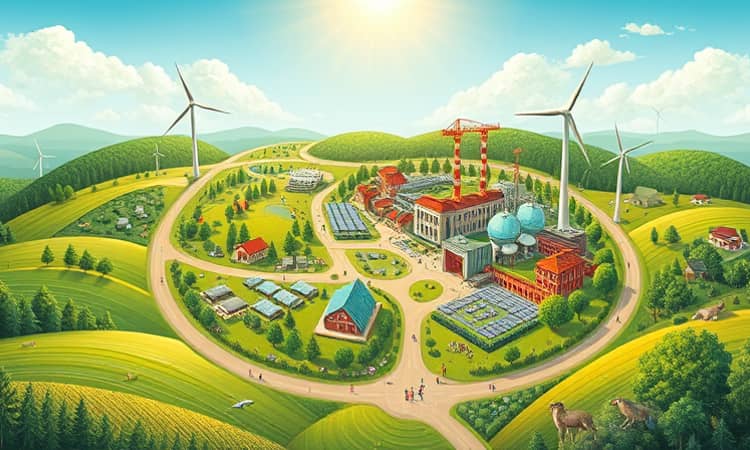
For decades, economic success has been measured by gross domestic product, corporate profits and stock market highs. But as climate risks intensify and social inequalities deepen, a new paradigm emerges: the eco-economy. This approach places human prosperity within the finite limits of our planet, rejecting an endless chase for growth and embracing systems that restore, renew and regenerate. Investors, policymakers and communities increasingly recognize that the future of wealth lies in aligning commerce with nature’s rhythms, ensuring that every financial decision supports life on Earth.
In 2026, the eco-economy is no longer theoretical. It is a dynamic, fast-growing sector attracting trillions in capital and charting a path toward inclusive, resilient prosperity. By integrating ecological boundaries, social justice and circular design, this model promises to transform how we produce, consume and invest. The time has come to move beyond traditional frameworks and embrace an economic system in which prosperity is measured by wellbeing and planetary health as much as by profit.
A New Vision for Sustainable Prosperity
The eco-economy draws on ecological economics and a rich tapestry of ideas—from degrowth movements to Indigenous knowledge—to forge a unified vision. It centers on holistic embedding in social-ecological systems, rejecting siloed decision-making and valuing the interconnections between people and nature. This perspective acknowledges that economic activity both depends on and impacts the living world, demanding a fundamental shift from extractive models toward regenerative ones.
At its heart are five guiding principles that balance human wellbeing, justice, planetary boundaries, efficiency and governance. These pillars ensure that prosperity does not come at the expense of future generations or the Earth’s capacity to support life. When correctly implemented, the eco-economy fosters green jobs, reduces disparities, safeguards biodiversity and aligns financial incentives with ecological realities.
Core Principles of the Green Economy
To operationalize the eco-economy, the Green Economy Coalition defined five interrelated principles. Each principle offers a compass for investors, businesses and governments aiming to create lasting value within finite planetary limits.
These principles embed justice and precaution at every stage, ensuring that economic policies reflect the intrinsic value of ecosystems and communities. By adhering to them, investors can align portfolios with sustainability goals and tap into emerging markets—from biodiversity restoration to green infrastructure.
Investment Opportunities Shaping 2026
Capital is increasingly flowing into strategies that deliver both financial returns and measurable environmental outcomes. As of late 2025, sustainable investing surpassed $3.7 trillion in assets under management, with Europe leading a surge in green bonds and resilience financing. The following areas stand out for investors seeking to harness the eco-economy’s momentum:
- Climate & Nature Solutions: Funding clean energy, sustainable agriculture and water management projects that avoid emissions and restore ecosystems.
- Green Bonds & GSS Market: Tapping into a €3 trillion bond market offering yields on par with conventional debt while financing decarbonisation and social initiatives.
- Decarbonisation Engagement: Targeting companies with net zero commitments and TCFD alignment, where governance engagement drives up to 12 percent higher peer-adjusted returns.
- Natural Capital & Biodiversity: Investing in forestry, regenerative agriculture and nature-positive funds to capture a potential $10.1 trillion in value and create millions of jobs.
- Adaptation & Resilience Infrastructure: Building climate-resilient cities, flood defenses and resilient agriculture in a market projected to reach $9 trillion by 2050.
- Energy Transition Infrastructure: Supporting next-generation grids, nuclear and data center expansions as global electricity demand surges 130 percent by 2030.
These themes demonstrate how investors can align portfolios with planetary priorities, from scaling technology to preserve biodiversity to financing the hard infrastructure needed for climate adaptation.
Regional Dynamics and Policy Context
Geographic nuances shape the pace and scale of eco-economy deployment. Europe maintains leadership with stringent circular economy mandates, comprehensive taxonomy rules and growing allocations by institutional investors. Asia is rapidly building sustainable debt markets and sees 80 percent of asset owners expecting asset growth in green sectors. In North America, engagement-driven strategies and private market innovation drive outperformance, with real estate funds incorporating climate risk data to enhance resilience.
Policy frameworks play a pivotal role. The EU’s circular economy package, COP30 commitments to triple adaptation finance and global net zero alliances provide investors greater clarity and accountability. Yet effective governance demands continued alignment of financial regulations with sustainability objectives, ensuring capital flows toward genuine impact rather than greenwashing.
Challenges and Enablers for Scaling Impact
Transitioning to an eco-economy is not without hurdles. Political headwinds, regulatory recalibrations and short-term profit pressures can stall progress. Data gaps on biodiversity outcomes and diverging AI ethics standards also pose risks for ESG integration.
Nonetheless, powerful enablers are emerging. The recalibration of major stewardship bodies like NZAM and NZBA strengthens corporate accountability. Technological advances in ESG analytics and the rise of sustainability-linked instruments further channel private finance into long-term ecological solutions. Crucially, inclusive democratic participation in economic decisions ensures that transitions benefit all communities and safeguard Indigenous rights.
Toward a Regenerative Future
The eco-economy offers a compelling narrative: one where economic activity restores ecosystems, uplifts communities and secures intergenerational equity. By embracing circular regenerative design closing resource loops and prioritizing innovation that serves the common good, investors can play a vital role in shaping a resilient planet.
As 2026 unfolds, stakeholders across sectors must collaborate to scale proven solutions, address policy gaps and align financial incentives with sustainability imperatives. In doing so, we unlock a future where prosperity and planetary health advance in harmony—a legacy worthy of our time.