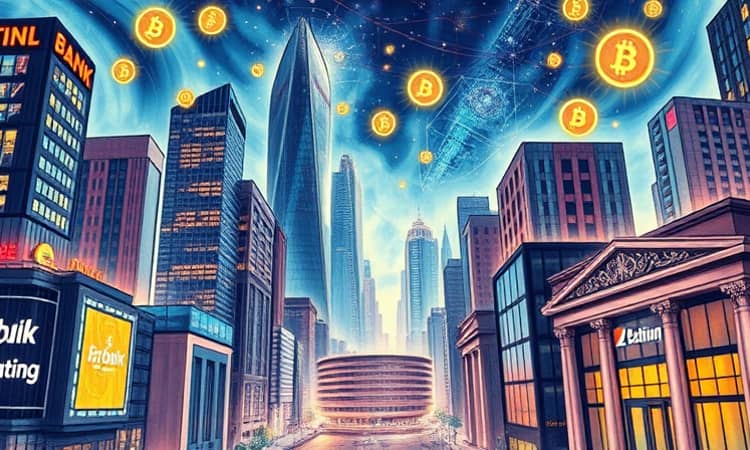
The financial world is undergoing nothing short of a transformative digital rebirth. What began as simple automation of banking processes has evolved into a full-fledged renaissance, where entirely native-digital assets, platforms, and rails underpin the global economy. From tokenized government bonds to AI-infused credit models, new instruments are emerging that promise to democratize access, improve efficiency, and challenge long-standing intermediaries.
By 2025, fintech is no longer an outsider—it's become core infrastructure for banking and insurance, accounting for more than 3% of global revenues and growing at roughly 21% annually. Traditional banks, tech giants, and decentralized finance platforms now coexist in a complex competitive and collaborative landscape, each vying to define money’s next chapter.
Macro Context: Finance’s Digital Foundation
Governments and regulators are racing to keep pace. In the European Union, a sweeping digital regulatory wave—embodied by MiCA, DORA, and the Data Act—lays down a horizontal framework designed to foster innovation while fortifying stability, consumer rights, and cybersecurity. Across Asia and North America, local initiatives echo similar ambitions, underscoring that regulation and competition policy are now as central to finance’s evolution as technology itself.
The real story, however, lies in how new digital assets are becoming the foundation of global liquidity, settlement, and value transfer. Gone are the days when financial institutions merely digitized ledgers; today, they are architecting entirely new ecosystems where programmable money, frictionless markets, and real-time risk management prevail.
Tokenized Real-World Assets and On-Chain Finance
One of the renaissance’s most compelling developments is the rise of tokenized real-world assets (RWAs). Through distributed ledgers, claims on everything from government bonds to trade finance receivables can now be represented as digital tokens. The benefits are profound:
- 24/7 trading and instant settlement with near-zero counterparty delay
- Fractional ownership opening markets to retail and institutional investors
- Programmable cash flows enabling automated dividend and interest distribution
- Bridging TradFi and DeFi ecosystems for enhanced liquidity and collateral
Leading banks and asset managers have piloted on-chain funds and tokenized deposits, locking in millions in assets under management. These initiatives demonstrate that tokenization is not a fringe experiment but a scalable bridge between regulated financial markets and permissionless innovation.
Cryptocurrencies, Stablecoins, and DeFi Infrastructure
Parallel to tokenization, decentralized finance (DeFi) continues to redefine financial intermediation. Lending, trading, derivatives, and structured products are increasingly executed via smart contracts rather than traditional middlemen. Governance tokens, liquidity pool tokens, and algorithmic yield strategies now constitute a novel asset stack.
Stablecoins, which offer instant cross-border transactions, have surged as private-sector digital cash alternatives, especially as the United States hesitates on its own CBDC project. Meanwhile, Europe’s MiCA framework promises clearer rules for crypto-assets, shaping where innovation hubs will flourish.
Central Bank Digital Currencies (CBDCs)
Central banks worldwide are piloting CBDCs to improve inclusion, efficiency, and resilience. Whether through wholesale platforms for interbank settlement or retail wallets for everyday payments, CBDCs promise to reduce cash dependency and lower transaction costs. Yet they introduce new risks around monetary policy transmission, cybersecurity vulnerabilities, and the potential disintermediation of commercial banks.
Cross-border CBDC initiatives aim to slash remittance fees and enable near-instant settlement, but they must balance privacy, sovereignty, and programmability. As public digital assets, CBDCs will coexist—and sometimes compete—with private stablecoins and traditional deposits, reshaping the monetary landscape in unpredictable ways.
AI and Data: Beyond Traditional Tokens
In this new era, intangible balance-sheet assets such as AI models and proprietary data sets have become strategic differentiators. By 2025, generative AI is recognized as critical infrastructure for fintech innovation.
- Fraud detection and prevention powered by machine learning
- Credit scoring and dynamic risk models driven by AI
- Automated compliance workflows, from KYC to AML
- Robo-advisory delivering hyper-personalized investment advice
Financial institutions and startups alike are racing to secure vast training data and enhance their decision-intelligence platforms. Proprietary AI confers superior risk management, operational efficiency, and user experience—but also raises questions about model transparency, algorithmic bias, and new cyberthreats targeting AI-enabled systems.
Structural Change in Financial Intermediation
Embedded finance and Banking-as-a-Service (BaaS) are ushering in “finance everywhere,” where non-bank platforms integrate payment, lending, and investment features directly into consumer journeys. Simultaneously, credit unions and traditional banks embrace fintech partnerships in a trend dubbed “fintegration,” modernizing legacy systems and attracting younger demographics.
- Embedded finance powering super-apps and e-commerce integrations
- Fintegration driving collaboration between credit unions, banks, and fintechs
- Regulatory adherence built into product design for strategic advantage
These shifts transfer customer relationships from balance-sheet owners to digital platforms, making user experience and data-driven personalization the new currency of trust and loyalty.
Embracing the Renaissance
As we navigate this digital renaissance, stakeholders must balance innovation with prudence. Policymakers must craft frameworks that protect consumers without stifling progress. Institutions need to cultivate cultures that embrace experimentation while managing emerging risks.
For investors, technologists, and regulators alike, the opportunity is immense. By harnessing tokenization, DeFi, CBDCs, AI, and embedded finance, we stand at the threshold of a more inclusive, efficient, and resilient financial system. The digital renaissance is not merely about new tools—it heralds a fundamental reimagining of money, trust, and value in the 21st century.