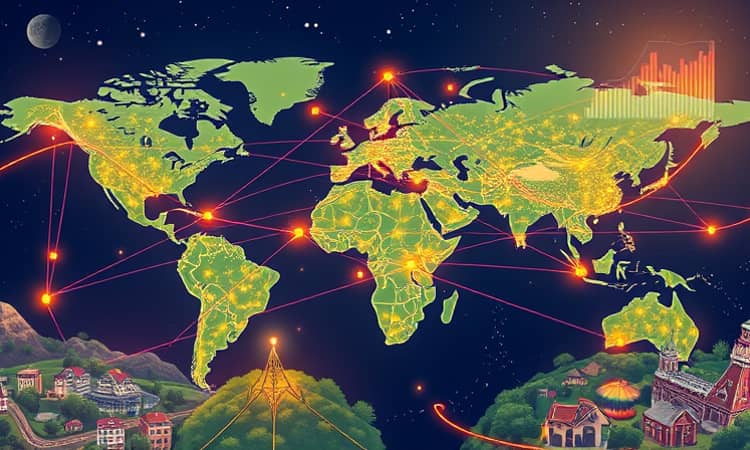
In today's rapidly evolving landscape, digital connectivity has emerged as a fundamental driver of progress, reshaping economies and societies at an unprecedented scale.
The connectivity dividend represents the vast benefits derived from leveraging digital technologies, offering a blueprint for sustainable development and prosperity.
From boosting GDP to creating millions of jobs, this phenomenon highlights how investing in robust digital infrastructure can transform lives and communities globally.
The Global Economic Impact of Connectivity
Digital connectivity is no longer a luxury but a critical utility, akin to electricity or clean water in its importance.
It serves as the backbone of global progress, breaking down barriers and amplifying human potential.
Statistics reveal a compelling narrative of growth and efficiency driven by digital investments.
- A 10% rise in broadband penetration can increase a nation's GDP by up to 2%, showcasing the direct economic impact.
- The digital economy now constitutes more than 17% of global GDP, expanding 2.5 times faster than traditional sectors.
- In 2023, the mobile ecosystem contributed USD 5.7 trillion to the global economy, generating over 32 million jobs.
These figures underscore how connectivity fuels macroeconomic stability and innovation.
Productivity gains are equally significant, with nations enjoying 30-40% higher outputs through advanced infrastructure.
Small and medium enterprises that adopt digital tools grow 2.5 times faster, demonstrating the transformative power of technology for businesses of all sizes.
Bangladesh: A Blueprint for Digital Transformation
Bangladesh offers a compelling case study in harnessing the connectivity dividend for national advancement.
In 2023, its digital economy contributed over USD 7.2 billion to GDP, with ICT exports reaching USD 1.9 billion.
The country has set an ambitious target of USD 5 billion in ICT exports by 2025, reflecting a commitment to digital growth.
- E-commerce is growing at 25% annually, with over 2,500 active digital marketplaces.
- Mobile financial services process over USD 260 million in transactions daily, enhancing financial inclusion.
- Freelancing comprises more than 1.5 million workers, contributing over USD 400 million annually.
This success is bolstered by accessible digital infrastructure and services.
Bangladesh ranks among the top 20 countries for mobile data affordability, with 1GB costing below USD 0.50.
Over 2,700 e-services are available through government portals, improving citizen access and efficiency.
Here is a table summarizing key connectivity dividend metrics from global and Bangladesh perspectives:
Understanding Connectivity Capital
The concept of connectivity capital provides a framework for why benefits vary across groups and regions.
It refers to a portfolio of assets, shaped by past investments, that enables access to and gains from the internet.
This capital transforms education, human skills, and social networks into digital advantages.
- Internet capitalization aggregates different asset types, but disparities can widen without inclusive policies.
- Multiplier effects through online platforms significantly boost the conversion of assets into connectivity capital.
- In China, creative industries and southeastern coastal areas benefit most, highlighting regional variations.
This framework explains the persistent digital divide and underscores the need for targeted interventions.
After infrastructure improvements, connectivity capital becomes the primary factor influencing dividend gains.
Bridging the Digital Divide
Despite progress, approximately 2.6 billion people remain offline, primarily in low-income countries.
This gap threatens to deepen inequalities, making inclusive digital transformation an urgent priority.
Digital tools, when deployed inclusively, have the potential to reduce socio-economic inequality by 25-30%.
- Universal connectivity is a significant challenge, requiring public policies and infrastructure development.
- Analogue complements, such as education and regulatory frameworks, are crucial to maximizing digital dividends.
- Initiatives like Bangladesh's 9,000+ Union Digital Centers have provided essential services to over 15 million rural citizens.
Addressing this divide is not just about access but ensuring that connectivity benefits all segments of society.
It involves fostering digital literacy and creating opportunities for marginalized communities.
Strategic Investments for Maximum Dividend
To leverage the connectivity dividend, investors and policymakers must adopt a holistic approach.
Digital connectivity is a critical determinant of national competitiveness, enabling participation in the global economy.
Growth, resilience, and prosperity increasingly depend on strong and inclusive digital foundations.
- Prioritize infrastructure upgrades to support broadband expansion and cloud technologies.
- Encourage SME digital adoption through incentives and training programs.
- Develop digital-first governance models for data-driven, citizen-centric services.
- Invest in sectors like fintech, telemedicine, and education technology to drive innovation.
Remote and hybrid work models can reduce operational disruptions by up to 70%, enhancing organizational agility.
Cloud usage in Bangladesh has grown over 200% since 2020, reflecting a rapid adoption of digital solutions.
By focusing on these strategies, stakeholders can unlock the full potential of a hyper-networked world.
The connectivity dividend offers a path to a more equitable and prosperous future for all.