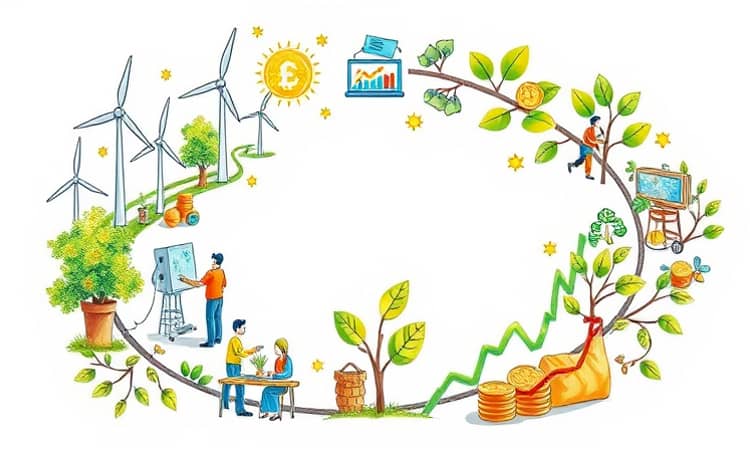
As the world faces mounting environmental challenges and resource scarcity, the convergence of finance and circular economy principles offers a beacon of hope. By reimagining traditional models, we can create systems where waste is minimized and value is preserved, benefiting businesses, communities, and the planet.
Through strategic capital flows and innovative instruments, circular finance as a catalyst empowers businesses to adopt restorative practices and stakeholders to support sustainable development. This article explores how financial institutions, investors, and policymakers can drive a transformative shift toward resource-efficient economies.
Understanding Core Concepts
At its heart, the circular economy model rejects the linear "take-make-dispose" approach, focusing instead on closed loops where materials and products retain their value indefinitely. Key strategies include reuse, repair, remanufacturing, recycling, and product-as-service models.
Circular finance refers to tools and investments that enable this transition. It directs capital toward projects that maximize resource efficiency, reduce waste, and promote sustainable production. By integrating environmental, social, and governance (ESG) criteria, circular finance aligns profitability with planetary stewardship.
Driving Benefits Across Sectors
The shift to circular models yields profound economic, environmental, and social gains. Companies that embrace circular strategies can lower production costs, buffer against commodity price swings, and unlock new revenue streams.
- Economic growth and resilience: Projected $4.5 trillion in additional output by 2030 with millions of new jobs in recycling and remanufacturing.
- Climate and biodiversity protection: Reduced emissions and pollution, while regenerating natural ecosystems.
- Enhanced brand loyalty: Consumers increasingly favor companies demonstrating environmental leadership.
Beyond corporate advantages, communities benefit from job creation in repair services and innovative sharing platforms, boosting inclusion and local prosperity.
Innovative Financial Instruments
Financial institutions are unveiling a suite of products designed to channel capital into circular projects:
- Circular loans and credit lines: Funding for eco-design, procurement of sustainable materials, and chemical phase-outs.
- Green bonds and sustainable funds: Bonds dedicated to renewable energy, energy efficiency, and waste reduction initiatives.
- Outcome-driven investments: Impact funds supporting agriculture, infrastructure, and resource management with clear ESG metrics.
These instruments not only finance projects but also embed long-term resilience criteria into business models, ensuring sustainable returns.
Frameworks for Capital Allocation
Leading institutions have devised comprehensive frameworks to guide sustainable resource allocation. A prime example is J.P. Morgan’s Sustainable and Inclusive Economy (SIE) Framework, which categorizes capital deployment into themes such as Climate Change, Natural Capital, Essential Needs, and Inclusive Growth.
Under Natural Capital, sub-themes like Sustainable Materials and Resource Management emphasize closed-loop production systems and biodiversity preservation. The framework maps challenges to outcomes, facilitating targeted investments and measurable progress.
Scaling Impact and Overcoming Barriers
While the potential is immense, scaling circular finance faces hurdles. Traditional ROI analyses often overlook life-cycle benefits, and intangible gains like brand reputation can be difficult to quantify. To overcome these barriers:
- Adopt Comprehensive Cost Assessments: Use Total Life Cycle Cost (LCC) methodologies to capture long-term savings and societal benefits.
- Strengthen Public-Private Partnerships: Co-financing and de-risking arrangements can lower capital costs for circular infrastructure.
- Enhance Data and Reporting Standards: Transparent ESG metrics and benchmarking tools build investor confidence.
By refining financial models and fostering collaboration, stakeholders can unlock a snowball effect, where success in one sector accelerates adoption in others.
A Call to Action
For investors, companies, and policymakers alike, the circular economy presents a powerful pathway to sustainable prosperity. Embracing circular finance is not merely an option—it is an imperative to safeguard finite resources, combat climate change, and create equitable growth.
To participate in this transformation, consider the following steps:
- Perform a material flow analysis to identify high-impact circular opportunities within your operations.
- Engage with financial partners to explore tailored circular financing solutions.
- Advocate for supportive policies and standards that encourage resource-efficient practices.
By taking decisive action today, we can collectively build a regenerative economy where financial flows enhance both human well-being and planetary health. The journey toward sustainable resource allocation begins now—join the movement and help shape a resilient, circular future.