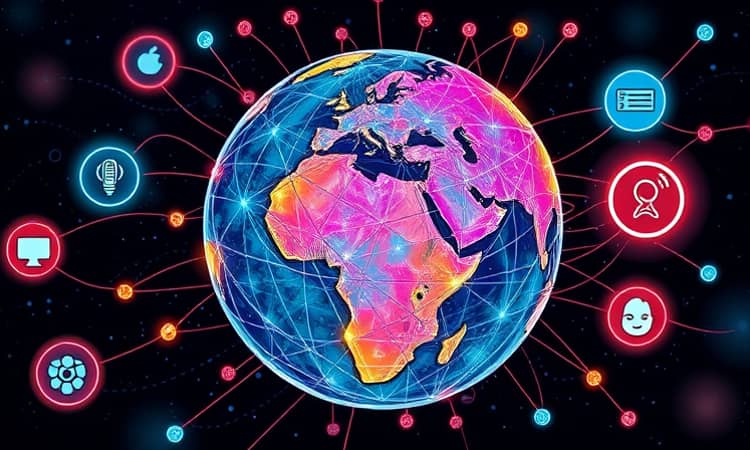
The global tech landscape is undergoing a seismic shift, driven by relentless innovation and unprecedented investment flows.
This evolution is not confined to traditional hubs but is spreading to emerging regions, creating new opportunities for startups and investors worldwide.
Understanding these trends is crucial for anyone looking to navigate the future of technology and capital.
The Global Tech Growth and Investment Landscape
Global tech sector growth is projected at a compound annual growth rate of 12–15% through 2026.
This surge is fueled by digital transformation and scalable tech solutions across industries.
Investment is diffusing beyond established markets like the US and China.
Emerging regions such as Southeast Asia, Africa, and Eastern Europe are becoming attractive hotspots.
These areas offer less saturated markets and strong demand for digital solutions.
They present higher risk but also higher growth potential compared to core markets.
- Overall tech sector growth is driven by digital transformation.
- New investment hotspots include Southeast Asia, Africa, and Eastern Europe.
- Corporate and government investments are surging in fields like quantum computing.
Corporate and government trends highlight a race toward quantum supremacy and AI-centric platforms.
Major firms like NVIDIA and Siemens are repositioning around AI infrastructure.
This signals multi-year capital expenditure into next-generation technologies.
Core Technology Waves Driving Innovation
Several key technologies are shaping the innovation tides, each with profound implications.
Agentic AI is moving from assistant roles to autonomous digital workers or AI coworkers.
By 2026, these agents will plan and execute workflows with minimal human oversight.
This drives demand for data infrastructure and opens new markets in agent platforms.
- Agentic AI advances include AI agents and AI-ready data as fast-moving technologies.
- Humanoid robotics is seeing early commercialization with costs dropping significantly.
- Quantum computing is shifting from theory to applied pilots and commercial stacks.
Humanoid robotics, with players like Figure AI and Boston Dynamics, is accelerating.
Manufacturing costs have fallen about 40%, pulling forward industrial deployments.
Quantum computing tackles problems impossible for classical computers, such as cryptography.
Spatial computing and extended reality are on a steeper adoption curve, with hardware innovations.
Apple's Vision Pro and Meta's leadership are driving market growth.
- Spatial computing benefits from hardware advances and applications in healthcare.
- Brain-computer interfaces are entering clinical reality for medical applications.
- AI for science and climate tech is reshaping industries with materials discovery and clean energy.
Brain-computer interfaces focus on clinical uses like motor restoration for patients.
AI for science accelerates discoveries in drug development and climate technology.
These technologies converge to create new investment and innovation hotspots globally.
Industrial and Platform Shifts: AI as Infrastructure
AI is becoming the operational foundation for industries, not just an add-on.
The Siemens-NVIDIA Industrial AI Operating System exemplifies this shift.
It embeds AI across the entire industrial value chain, from design to supply chains.
This turns digital twins into active, AI-driven systems for continuous optimization.
- Siemens will accelerate simulation portfolios with GPU technology for speed-ups.
- An AI factory reference site launches in 2026 in Erlangen, Germany, with partners like Foxconn.
- Samsung's ecosystem vision integrates AI across devices and services for personalized experiences.
Samsung's AI living concept treats AI as a system-wide design principle.
It spans displays, appliances, and health platforms via the SmartThings ecosystem.
This approach enables continuous optimization at scale for consumers.
These shifts highlight how AI is redefining production and daily life.
Geographic Hotspots: Where Innovation Thrives
Innovation is decentralizing, with new tech corridors emerging globally.
In the United States, growth extends beyond Silicon Valley to regions like North Carolina and Texas.
North Carolina's Research Triangle attracts investment in AI research and biotech analytics.
Texas, with Austin's Silicon Hills, supports AI-focused SaaS and enterprise solutions.
Colorado is growing an AI startup ecosystem with strong data-science talent.
Virginia hosts the world's largest concentration of data centers, supporting cloud infrastructure.
Other states like Ohio and Utah are expansion sites for hyperscale facilities by tech giants.
Globally, regions in Asia and Europe are also rising as key players in tech innovation.
- Emerging markets in Southeast Asia offer digital solution demand.
- Eastern Europe provides less-saturated markets for startups.
- Africa is attracting investment for scalable tech solutions.
These hotspots benefit from local demand and supportive ecosystems.
Investment Flows and Future Outlook
Investment trends indicate a focus on high-growth technologies and regions.
Venture capital is flowing into startups around agentic AI and quantum algorithms.
Corporate investments are targeting AI infrastructure and robotics commercialization.
By 2026, the tech landscape will be defined by autonomous systems and global diffusion.
Future outlook includes broader adoption of humanoid robots and quantum advantage.
- Investment in quantum computing is surging with government and corporate backing.
- Robotics deployments are expected in industrial settings by 2026-2028.
- Spatial computing units may ship over 40 million per year by 2026.
Climate tech will become a strategic industry with long-term importance.
AI for science will accelerate breakthroughs in materials and drug discovery.
These trends promise to drive economic growth and solve global challenges.
To capitalize on these tides, stakeholders must embrace innovation in emerging technologies.
Focusing on scalable solutions and regional opportunities can yield significant returns.
The future is bright for those who navigate these tech tides with insight and agility.