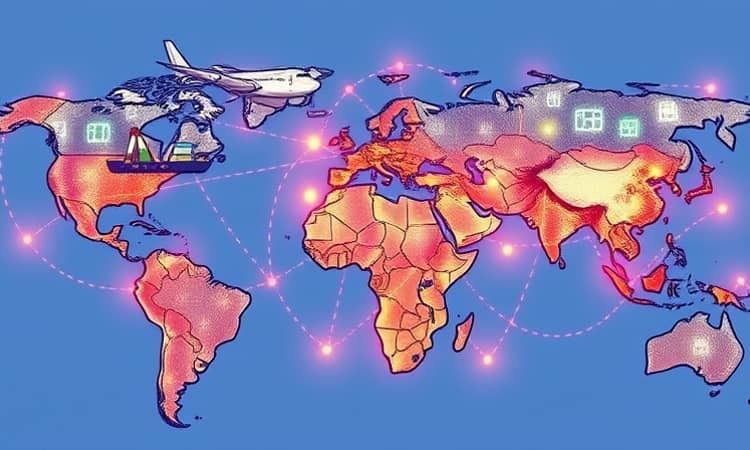
In 2026, businesses face unprecedented challenges in keeping products moving amid trade disputes, shifting regulations, and technological upheaval. As tariffs rise and geopolitical tensions flare, leaders must prioritize supply chain reliability and agility to safeguard growth and profitability.
Gone are the days when inventory optimization alone was sufficient. Today’s landscape demands data-driven strategies for systemic resilience, elevating supply chain functions to strategic partners in corporate decision making.
Understanding the New Supply Chain Landscape
Supply chains now operate under intense regulatory complexity and volatility. Recent surveys show 72% of trade professionals cite U.S. tariff volatility as their top concern, a dramatic rise from 41% just one year earlier. These unpredictable costs inflate raw material prices, compress margins, and create compliance burdens that can stall customs clearance and project timelines.
The ripple effects are profound. Higher logistics expenses, sourcing uncertainty, and quality control issues have forced many companies to reconfigure their networks. One-quarter of developing economies still trail 2019 living standards, highlighting the global stakes of persistent trade disruptions.
Operational inefficiencies compound the problem. Over half of firms report chronic oversupply issues, while fewer than 12% have implemented robotic process automation, leaving teams mired in manual tasks and limiting strategic focus.
Broader risks loom, too. Global inflation, projected at 3.1% in 2026, combined with climate shocks and regional instability, threatens to upend fragile progress and widen economic disparities.
Economic Outlook and Regional Growth Projections
Despite headwinds, global growth is expected to hover between 2.6% and 3.3%, the slowest decade since the 1960s. Continued investment in technology, fiscal support, and adaptive policies will be crucial to offset trade-related setbacks.
These figures underscore stark regional disparities: Asia continues to outpace Europe and North America, while emerging markets bear the brunt of debt burdens and climate-related shocks.
Strategic Responses for Enhanced Resilience
- Nearshoring and reshoring initiatives to minimize tariff exposure and shorten lead times
- Renegotiating contracts and partnership terms to build flexibility into procurement agreements
- Diversified supply chains across multiple regions to reduce dependency on any single geography
- Customer-centric integration aligning KPIs across commercial, finance, and operations teams
- Sustainability and ESG compliance as core pillars of supplier selection and energy management
- Just-in-case inventory reduction to free up working capital and improve cash flow
Technology and Innovation as Catalysts
Technology adoption has accelerated sevenfold since 2024, with 40% of companies exploring AI and blockchain solutions. Leading applications include data analytics (58%), ERP automation (56%), supply chain management (55%), and real-time visibility platforms (54%).
Organizations with robust big data foundations (47%) are rapidly scaling to AI-powered analytics and prediction, enabling proactive risk mitigation. Gartner predicts that by 2028, 25% of all KPIs will be driven by artificial intelligence, while the GenAI market could reach $58.5 billion by 2031.
Automation through RPA and cloud-based platforms transforms transactional tasks, allowing teams to focus on strategy rather than routine operations. Equally important is the shift to multi-tier visibility and decentralized intelligence, empowering local units and suppliers to collaborate in real time.
Building a Future-Ready Supply Chain
True resilience emerges from a culture that embraces change. Leaders must foster cross-functional collaboration and invest in upskilling programs that prepare employees for digital workflows. Shared dashboards and integrated planning tools break down silos between procurement, finance, and operations.
Partnership models are evolving. Co-creation with suppliers and service providers ensures innovation pipelines remain robust. As one executive notes, "Winning supply chains are shifting from centralized control to decentralized intelligence," highlighting the importance of agile networks over monolithic structures.
Conclusion: Embracing Resilience
The challenges of 2026 demand a holistic approach to supply chain transformation. By combining strategic nearshoring, advanced technologies, and a collaborative mindset, organizations can build networks that withstand shocks and capture growth.
Resilience is not a destination but a continuous journey. As companies refine their strategies and leverage data-driven insights, they will unlock new opportunities and reinforce the foundation of a truly global, resilient economy.