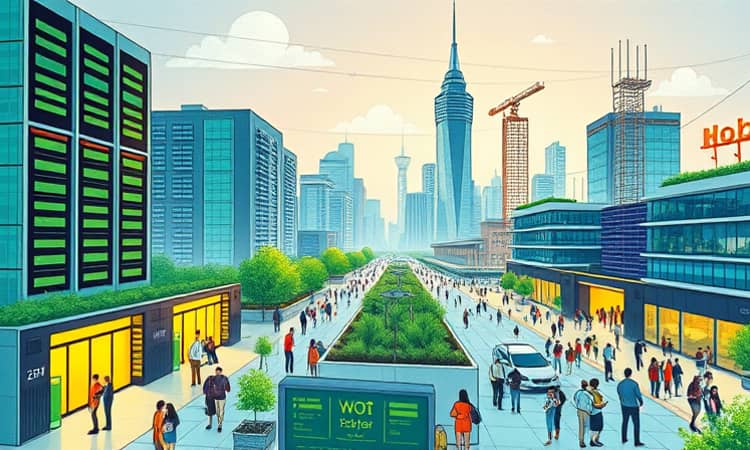
In an era of unprecedented change, the global real estate market stands on the brink of a profound transformation and rebirth.
After years of correction and uncertainty, a new cycle is emerging, promising opportunities for those ready to adapt.
This outlook delves into the forces shaping property investments worldwide, from macro-economic shifts to technological revolutions.
Understanding these dynamics is crucial for navigating the future landscape.
The journey begins with recognizing that asset values have repriced significantly, creating fertile ground for strategic investments.
As we look ahead to 2026 and beyond, the market is set to evolve in ways that redefine traditional paradigms.
Macro Backdrop: The Turning of the Cycle
The global property cycle is transitioning from a phase of correction to the dawn of a new growth era.
Major players like Hines, JLL, Morgan Stanley, and Apollo point to 2024-2025 as the stabilization period.
They highlight 2026 marking the start of an up-cycle in many regions, driven by renewed investor confidence.
Economic factors play a pivotal role here.
GDP growth remains modest but positive across most economies, avoiding a broad recession.
Inflation is moderating, yet interest rates are settling above pre-2020 norms.
This leads to structurally higher capital costs, which reshape financing strategies and investment returns.
Capital markets are showing signs of revival.
Transaction activity strengthened in the latter half of 2025, with momentum expected to build through 2026.
Forecasts indicate that global real estate investment turnover will exceed $1 trillion in 2026, the highest since 2022.
Key elements driving this shift include:
- A synchronized slowdown in new construction due to high costs, limiting supply.
- Replacement costs now exceeding current asset values in many markets, supporting existing properties.
- Debt markets expanding, with commercial mortgage issuance more than tripling since 2023.
The bid-ask spread is narrowing, as buyers and sellers align on pricing in this new normal.
This alignment is essential for market liquidity and growth.
Structural Themes Reshaping Real Estate
Beyond cyclical changes, deep structural themes are redefining the property landscape.
These forces are not just trends but fundamental shifts that will dictate market success.
Technology and AI have emerged as massive drivers of real estate demand.
AI infrastructure requires unprecedented capital-intensive build-outs, with Barclays estimating $2.3 trillion committed to data centers in one year alone.
This creates immense opportunities for:
- Data centers and power-intensive industrial sites.
- Specialized land with access to power and fiber networks.
Moreover, AI is transforming operations through predictive maintenance and energy optimization.
Buildings are increasingly integrated with energy systems, featuring on-site renewables and battery storage.
Demographics and migration are shaping demand in diverse ways.
Young, growing populations in markets like India and Saudi Arabia fuel need for housing and retail.
Meanwhile, aging populations in developed economies drive demand for senior housing and healthcare real estate, creating stable investment niches.
Climate, ESG, and regulation are becoming non-negotiable factors.
Regulations such as the EU's Energy Performance of Buildings Directive are tightening efficiency standards.
This widens the pricing gap between green and brown assets, making sustainability a core value driver.
Retrofitting older stock is essential, and climate risks are being priced into valuations.
Geopolitics and supply chains are redrawing global maps.
Trade tensions boost demand for logistics space in alternative hubs like Southeast Asia and Mexico.
This supports manufacturing and logistics real estate are thriving in these regions, driven by onshoring strategies.
Social trends emphasize the experience economy over mere space.
Consumers seek experiential retail and high-amenity offices, with top-tier offices see solid demand despite hybrid work trends.
Cross-Cutting Commercial Real Estate Trends
In 2026, efficiency is paramount in a higher-cost world.
Companies are laser-focused on reducing expenses and optimizing space usage.
Construction cost inflation persists but is cooling, with regional variations.
For instance:
- Europe sees cost inflation of ~2.7-3% in the UK and Germany.
- The US experiences 3.5-4% inflation.
- Singapore and Australia face 5-6% increases.
Supply shortages are intensifying for top-quality space across sectors.
Key examples include:
- Office development in the US at all-time lows, with completions falling 75% in 2026.
- Global industrial/logistics deliveries 42% below 2023 peak levels.
- Multifamily and retail supply near historic lows in mature markets.
Democratization of investing is expanding access to real estate.
Growth in non-traded REITs and direct-to-consumer platforms allows more individuals to participate.
This trend enables strategic investments and resilient portfolios for a broader audience.
Sector-by-Sector Global Outlook
The residential sector faces chronic undersupply, with affordability crises in many markets.
In the US, a shortfall of ~4 million homes is projected by 2029, while Europe grapples with underbuilding issues.
Key projections for the US housing market in 2026 include:
- Home sales increasing about 14% nationwide.
- Home price growth of 2-3%, with wage growth potentially improving affordability.
- Mortgage rates lower than 2025 but above pre-2020 levels.
Supply dynamics show slight improvements, but zoning constraints continue to hinder development.
Regional divergences persist, with some areas outperforming others.
To illustrate regional variations, consider the following table summarizing key forecasts:
This table highlights the diverse challenges and opportunities across the globe.
It underscores the need for localized strategies in a reimagined real estate landscape.
Conclusion: Embracing the Future
The global property market is reimagining itself through innovation and adaptation.
By leveraging technology, addressing demographic shifts, and prioritizing sustainability, stakeholders can thrive.
As we move forward, the focus must be on strategic investments that align with these evolving trends.
The opportunities are vast for those who dare to rethink real estate and embrace this new era.