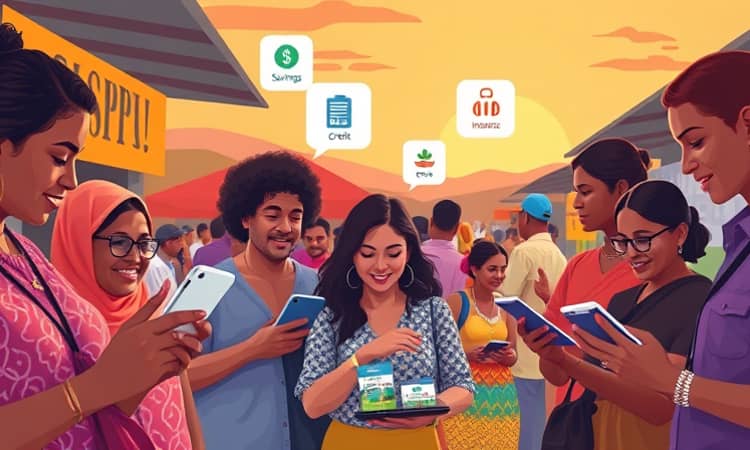
In today's interconnected world, financial systems hold the power to transform lives, yet millions remain excluded from their benefits.
Access to affordable financial tools is not just a privilege but a cornerstone for economic empowerment and social equity.
The terms unbanked and underbanked highlight persistent gaps in our global economy, urging us to rethink how services are delivered.
Defining Financial Inclusion
Financial inclusion means ensuring that everyone, regardless of income or background, can use safe and useful financial products.
It goes beyond mere account ownership to encompass services like payments, savings, credit, and insurance.
This approach is designed to enhance financial resilience and well-being while reducing disparities across communities.
- Unbanked individuals lack any formal account at a bank or regulated provider, relying solely on cash.
- Underbanked people have an account but still face barriers to essential services, often turning to non-bank alternatives.
- Inclusive finance aims to bridge these gaps by offering tailored solutions that meet diverse needs.
Understanding these definitions is the first step toward addressing the root causes of exclusion.
The Global Landscape of Financial Inclusion
Recent data reveals both progress and persistent challenges in account ownership worldwide.
Globally, 79% of adults now have an account, up from 74% in 2021, indicating steady growth.
However, 1.3 billion adults remain unbanked, with over half concentrated in just eight countries.
This table underscores the uneven distribution of financial access, highlighting regions in need of targeted interventions.
- In low- and middle-income economies, 75% of adults have accounts, but digital adoption is accelerating.
- Sub-Saharan Africa saw account ownership rise from 49% to 58%, driven by mobile money innovations.
- South Asia boasts nearly 80% account ownership, with India leading at about 90% for both men and women.
Demographics show that women and poorer households are disproportionately excluded, with 55% of the unbanked being female.
This disparity calls for gender-sensitive strategies to ensure equitable access.
Why Inclusion Matters: Drivers and Benefits
Financial inclusion is linked to broader societal gains, from economic growth to individual empowerment.
It provides a pathway out of poverty for hundreds of millions, fostering resilience in times of crisis.
By enabling savings and credit, it helps families build wealth and participate more fully in the economy.
- Economic growth and poverty reduction are key outcomes, as inclusive finance spurs market opportunities.
- Household resilience improves when people have tools to manage shocks, such as insurance or emergency funds.
- Gender equality advances by addressing the gap where women are 9 percentage points less likely to own phones.
Moreover, inclusive finance supports digital economies, unlocking potential for informal businesses and communities.
The shift from mere access to measuring financial health and empowerment reflects a deeper commitment to sustainable development.
Barriers to Access: Overcoming Obstacles
Despite progress, numerous barriers hinder financial inclusion for the unbanked and underbanked.
Affordability is a major hurdle, with high fees and minimum balances pricing out low-income individuals.
Lack of documentation and KYC barriers exclude informal workers who lack official IDs or proof of address.
- The digital divide limits access, as only 75% of adults with primary education own phones versus 93% with higher education.
- Trust issues arise from poor consumer protection, making people wary of financial institutions.
- Financial capability gaps mean many lack the literacy to navigate complex products safely.
These challenges are compounded in rural areas, where infrastructure is weak and services are scarce.
Addressing them requires innovative solutions that prioritize accessibility and user-centric design.
Solutions and the Way Forward
Technology plays a pivotal role in expanding financial access through mobile money and digital platforms.
Policies that promote affordable and appropriate products can bridge gaps, especially for marginalized groups.
Collaboration among governments, NGOs, and private sector actors is essential to scale impact.
- Mobile banking initiatives have proven effective in regions like Africa, where formal savings rose by 12 points.
- Simplified KYC processes can include alternative IDs to reach those without traditional documentation.
- Financial education programs empower users to make informed decisions and build trust in systems.
Emerging debates focus on ensuring that digital tools do not exacerbate inequalities but instead foster inclusivity.
By leveraging data and community feedback, stakeholders can design interventions that are both sustainable and impactful.
Conclusion: A Call to Action
Reaching the unbanked and underbanked is not just a financial imperative but a moral one.
It demands a concerted effort to dismantle barriers and create opportunities for all.
As we move forward, let us champion innovative and inclusive approaches that leave no one behind.
Together, we can build a world where financial tools empower every individual to thrive.