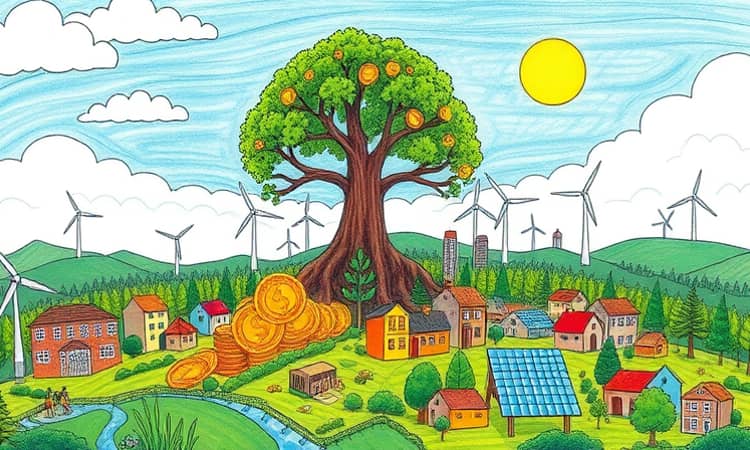
In an era shaped by climate urgency and evolving investor values, green finance has emerged as a transformative force. What was once a niche segment is now at the forefront of global capital markets, driving the shift toward a more sustainable, low-carbon economy.
The following exploration delves into the remarkable expansion of green finance, uncovers its core drivers, analyzes regional dynamics, and offers practical insights for investors, policymakers, and stakeholders seeking to contribute to a greener tomorrow.
Market Size and Growth Projections
Green finance markets are experiencing rapid expansion worldwide. Projections indicate the global sustainable finance market will swell from USD 7.95 trillion in 2025 to a breathtaking USD 42.68 trillion by 2035, achieving a CAGR of 18.3% between 2026 and 2035. Alternative estimates echo this growth story, forecasting increases from USD 7.38 trillion in 2025 to over USD 30 trillion by 2034 at a CAGR of 16.38%.
Meanwhile, the green bond verification market alone is set to nearly double, climbing from USD 8.19 billion in 2025 to USD 16.90 billion by 2035 (CAGR 7.51%). Forecasts for 2026 already anticipate issuance of $530 billion in green bonds, alongside social and sustainable bond volumes exceeding $800 billion total.
These figures underscore the magnitude of opportunity as capital markets increasingly align with environmental imperatives.
Key Drivers and Trends
A confluence of forces is propelling green finance forward:
- Rising ESG demand: Corporations are embedding robust environmental, social, and governance goals into their core strategies, while investors demand transparency and anti-greenwashing safeguards via third-party verification.
- Renewable energy financing: Solar, wind, and hydro projects dominate green bond portfolios, delivering measurable reductions in greenhouse gas emissions and attracting strong investor interest.
- Regulatory and government support: Initiatives like the EU Action Plan, NextGenerationEU Green Bonds (€78.5 billion issued by 2025), and national taxonomies in emerging markets are cementing sustainable finance frameworks.
- Innovation in financial products: From green bonds to sustainability-linked loans and voluntary carbon markets, novel instruments are diversifying capital flows and targeting specific climate solutions.
At the same time, the industry faces challenges such as standardization of criteria and the risk of superficial commitments. Addressing these through rigorous impact assessments and transparency will define the next chapter of growth.
Regional Breakdown
While green finance is a global phenomenon, dynamics vary by region:
- Europe: Commanding roughly 40% of the sustainable finance market, Europe leads in issuance volume, regulatory innovation, and investor appetite.
- Asia-Pacific: The fastest-growing region, driven by China’s green bond surge and national initiatives in Japan, South Korea, and Australia.
- Middle East and Africa: Emerging green finance hubs focusing on renewable energy, water resilience, and disaster mitigation projects.
North and Latin America continue to build momentum through public-private partnerships, while specialized frameworks—such as Colombia’s Green Taxonomy and the GGGI-Agrobank collaboration—expand access to sustainable financial tools.
Segments and Applications
Green finance spans a spectrum of certifications, instruments, and industries:
- By type: Certifications and EIAs (environmental impact assessments) ensure credibility, while verification services for renewable projects exhibit the highest growth rates.
- By application: Renewable energy projects hold the largest market share, followed by environmental protection initiatives targeting biodiversity, climate mitigation, and sustainable agriculture.
- By industry: Transport and logistics, green construction, electric vehicles, sustainable packaging, and sustainable real estate are top verticals benefiting from green debt issuance.
These segments illustrate how capital is mobilized to address specific environmental challenges and create tangible impact.
Key Players and Recent Developments
The green finance ecosystem encompasses a diverse cast of actors:
- Specialized green banks and development finance institutions offering loans, guarantees, and technical assistance.
- Sustainable asset managers integrating ESG factors into multi-trillion dollar portfolios.
- Impact funds targeting nature-based solutions, clean energy startups, and community resilience projects.
- Corporations issuing green bonds to finance emission reduction initiatives and sustainable infrastructure.
Notable recent milestones include the EMSTEEL Green Finance Framework (May 2025), Colombia’s taxonomy rollout (April 2025), and the GCF-backed GGGI-Agrobank initiative, all of which exemplify the innovation and collaboration driving market maturity.
Future Outlook and Actionable Insights
As sustainable debt volumes ascend, 2026 is poised to be a watershed year, with forecasts predicting green bond issuance exceeding $700 billion and total sustainable bond volumes approaching $1 trillion. Market composition is expected to evolve, with more sustainability-linked debt products and blended finance structures to de-risk emerging market investments.
For investors and decision-makers seeking to harness the power of green finance, consider these actionable steps:
- Engage with recognized frameworks such as the Green Bond Principles and the EU Taxonomy to ensure alignment with best practices.
- Incorporate rigorous impact assessments and third-party verification to safeguard against greenwashing.
- Collaborate across sectors—government, finance, and civil society—to scale innovative instruments and share data.
- Prioritize projects with measurable environmental outcomes, from renewable energy deployments to nature-based solutions.
By embracing sustainability-aligned capital and leveraging the lessons of early adopters, stakeholders can unlock new growth opportunities while delivering critical climate benefits.
Green finance’s ascent is not merely a market trend; it is a catalyst for a more resilient planet. As investors, institutions, and communities unite under the banner of sustainable growth, the horizon of possibility expands—ushering in a future where finance and nature thrive in harmony.