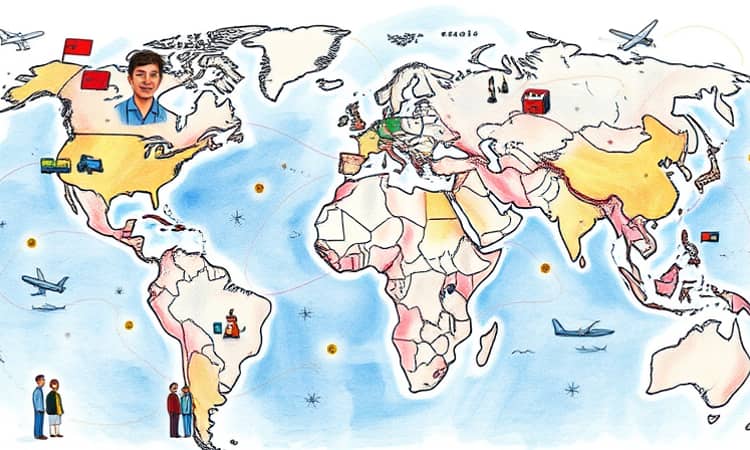
In an era of shifting geopolitics and economic disruptions, global connectivity remains a powerful engine driving growth and opportunity. Investors seeking long-term returns must understand how trade, capital, technology, and people weave together in a diversified supply chains and partnerships fabric that transcends borders.
Rather than a retreat from globalization, we witness an evolution toward regional hubs and digital linkages. This article explores the current landscape, highlights key data, and offers strategies for investors to harness the potential of a truly borderless digital transformation and data flows.
The Big Picture: Globalization Reshaping
Despite rising headlines on de-globalization, the DHL Global Connectedness Index reached a trading at record highs in 2024 of 25.1%, nearly matching the 2022 peak of 25.5%. Approximately 22% of global GDP is traded internationally, close to the 2008 record, while 80% remains domestic.
The real story is re-wiring, not reversing: supply chains are becoming more resilient, with manufacturers diversifying suppliers and building regional hubs in Asia, Europe, and the Americas. Meanwhile, digital and information flows continue to accelerate, knitting markets together in new ways.
Yet risks of fragmentation persist. The World Economic Forum warns that splitting financial systems into blocs could cost up to US$5.7 trillion, while trade fragmentation is projected to slow global growth to around 2.3% in 2025—below pre-pandemic norms.
Current Macro and Trade Context
Global growth projections have softened but remain positive. The World Bank expects roughly 2.5% average annual growth through 2027, about three quarters of the 2010–2019 norm. The OECD forecasts a dip from 3.2% in 2025 to 2.9% in 2026, rebounding to 3.1% in 2027.
Trade volumes have proven remarkably resilient. UNCTAD reports Q1 2025 goods and services trade up 1.5% quarter-on-quarter, with services outpacing goods at roughly 9% annual growth. Developing countries have driven recent gains, though in early 2025 developed markets surged on strong U.S. imports and EU exports.
- Global goods trade volumes in H1 2025 grew at the fastest pace since 2010, excluding the Covid rebound.
- Seasonally adjusted volumes were 3% higher than H2 2024 and 4% above full-year 2024.
- DHL forecasts 2.5% annualized trade growth for 2025–2029, matching recent decades.
Policy shocks have tested this resilience. U.S. tariffs hit an 18.2% average effective rate in July 2025, the highest since 1934. Yet many countries have diversified away from U.S. markets, redirecting exports to Europe, Mexico, and Canada, and forging bilateral and regional trade agreements.
- China increased exports to Europe by 6% and to Mexico/Canada by 25%, offsetting U.S. demand losses.
- Higher tariffs spurred trade diversion that created new winners in emerging markets like Mexico and Southeast Asia.
- Bilateral and regional pacts help companies sidestep tariffs and maintain cross-border flows.
Detailed Structure of Global Interconnectedness
Cross-border activity unfolds across trade, capital, information, and people flows. While goods and services plug into complex supply chains, capital and data traverse borders at record rates, and people mobility gradually recovers from pandemic lows.
This data illustrates both depth—high trade volumes relative to GDP—and breadth, with flows distributed among diverse partners. While some geopolitical camps show modest reorientation, most countries maintain multi-directional linkages.
Capital Flows and Investment
Foreign direct investment remains robust. DHL reports that greenfield FDI announcements have grown faster than overall capital expenditure. In the U.S., interstate greenfield projects still outpace reshoring, and cross-regional M&A deals hold steady.
However, the specter of financial fragmentation looms large. The WEF and Oliver Wyman estimate a cost of US$0.6–5.7 trillion from splitting global banking and capital markets into separate blocs—underscoring the economic value of cross-border finance.
For investors, targeting massive investment opportunities in friendshoring destinations—such as Vietnam, India, Mexico, and Central Europe—can capture upside from manufacturing realignment and regional trade pacts.
Information and Digital Flows
Information is the fastest-growing flow type, surpassing goods and capital in globalization. Internet traffic, cloud services, and digital platforms drive a information is the most globalized flow surge, enabling remote work, e-commerce, and AI innovation.
Yet a digital divide persists. UNCTAD highlights limited internet access in low-income nations, hindering participation in the borderless digital economy. Investments in undersea cables, satellite internet, and local data centers can bridge this gap and unlock new markets.
People Flows and Mobility
International mobility—travel, migration, and students—remains the least globalized flow, but it is rebounding. Business travel and tourism have recovered strongly, while remote work policies encourage global talent movement.
Remittances to emerging markets reached record levels, sustaining consumer demand and fostering financial inclusion. Education and professional exchanges continue to knit communities, underlining that human capital remains a vital thread in the borderless economy.
Strategies for Investors in a Borderless Economy
- Diversify across regional hubs: allocate to manufacturing and service centers in Asia, Europe, and the Americas.
- Capitalize on tariff-driven winners: seek exposure to markets benefiting from trade diversion, like Mexico and Southeast Asia.
- Invest in digital infrastructure: fund undersea cables, data centers, fintech platforms that bridge the digital divide.
- Target greenfield FDI hotspots: back countries specializing in friendshoring and nearshoring solutions.
- Embrace environmental, social, and governance criteria: support technologies and companies that enhance global resilience and inclusion.
In a world of evolving geopolitical dynamics, global interconnectedness endures as a powerful growth driver. By understanding trade patterns, capital flows, digital linkages, and people mobility, investors can navigate volatility and capture long-term value in the borderless digital economy.
Embrace the re-wiring of globalization: invest in diversity, resilience, and innovation across borders to unlock sustainable returns and contribute to a more integrated, prosperous world.