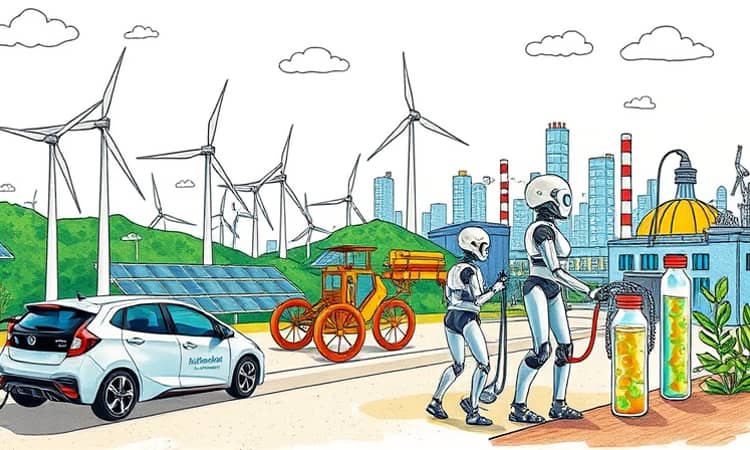
In an era defined by rapid technological breakthroughs and global shifts, aligning your investments with long-term structural trends is crucial. By focusing on tomorrow’s key sectors, you can enhance resilience and capture above-trend growth.
Why Future-Proofing Matters
We live in a world shaped by powerful structural megaforces—from AI-driven productivity surges to a global low-carbon transition. According to BlackRock, these forces will define market winners and losers over the next decade, cutting across industries and geographies.
The World Economic Forum emphasizes that capturing productivity gains from AI and advanced technologies will be central to economic futures by 2030, particularly in services, energy, advanced manufacturing, and construction. At the same time, capital is flooding into “deep tech” sectors, with StartUs Insights projecting growth from USD 41 billion in 2024 to USD 714.6 billion by 2030 at a 48.2% CAGR.
Portfolios aligned with these structural shifts are not only more resilient against volatility but also positioned to benefit from enduring growth drivers. Whether you’re an individual investor or managing institutional funds, focusing on future-proof sectors can unlock sustainable returns.
Harnessing Artificial Intelligence & Automation
Artificial intelligence is no longer niche—it’s a fastest-growing industry globally, projected to expand at roughly 27–28% CAGR to 2030. Generative AI alone saw 80% of organizations boost investments in the past year, according to Capgemini, illustrating near-universal engagement.
AI’s impact spans virtually every sector: financial services, healthcare, energy utilities, ICT, advanced manufacturing, and more. Investors can access this theme through pure-play AI infrastructure like semiconductors, or by backing industry leaders embedding AI in their offerings.
- Semiconductor & AI infrastructure: GPUs, accelerators, data center REITs
- Enterprise software platforms with embedded AI solutions, including cloud and CRM suites
- Robotics and automation plays in logistics, healthcare, and industrial operations
- Diversified ETFs & funds targeting AI and robotics exposure
Venture capital flows underscore this momentum—Gen-AI companies raised USD 56 billion in 2024, while AI-powered industrial robotics is on track to reach USD 36.11 billion by 2030 at a 24.7% CAGR.
Exploring Deep Tech Innovations
Deep tech represents a meta-theme spanning AI, quantum computing, spatial computing, advanced materials, and biotech. StartUs Insights highlights trends such as agentic AI systems, commercial quantum applications, post-quantum cryptography, and spatial computing through AR/VR and digital twins.
Governments and corporates alike are directing resources toward these frontiers. Global commitments include USD 42 billion for quantum R&D, and enterprise security budgets for post-quantum cryptography rose 15.1% year-on-year in 2025.
Quantum computing promises breakthroughs in portfolio optimization, drug discovery, and climate modeling by simulating complex molecules. Spatial computing is revolutionizing healthcare diagnostics and industrial training, while biotech firms leverage metabolomics and AI-driven drug design to accelerate novel therapeutics.
For investors, deep tech exposure can be gained via specialized public companies and thematic funds focusing on:
quantum hardware and software providers, AR/VR platform leaders, cybersecurity firms building post-quantum defenses, and biotech innovators at the intersection of AI and precision medicine.
Investing in Renewable Energy & Low-Carbon Transition
The global renewable energy market is expected to exceed USD 2 trillion by 2030, growing at CAGRs between 8.5% and 16.9%, driven by climate policies, corporate procurement mandates, and cost declines in solar and wind technologies.
India’s Nationally Determined Contributions aim for 50% of installed capacity from non-fossil sources by 2030, underscoring the scale of the upcoming build-out. Meanwhile, AI could reduce 3–6 gigatonnes of CO₂-equivalent emissions annually by 2035 through optimization of power grids and supply chains.
- Utility-scale solar and wind developers and operators
- Grid modernization technologies, including inverters, smart meters, and demand-response platforms
- Battery storage solutions such as lithium-ion, solid-state, and flow batteries
- Emerging energy carriers like green hydrogen and advanced nuclear
Capitalizing on Electric Vehicles & Future Mobility
The electric vehicle market is accelerating rapidly. In India alone, EV market value could soar from USD 3.21 billion in 2022 to USD 113.99 billion by 2029, reflecting a 66.5% CAGR. Global battery markets are likewise expanding, with cell and pack segments forecast to grow from USD 16.77 billion in 2023 to USD 27.70 billion by 2028.
Policy incentives, stricter emissions standards, and consumer demand for sustainable transport are key drivers. Moreover, the convergence of AI and mobility—through autonomous driving software and smart city infrastructure—is unlocking new revenue streams.
- Vehicle manufacturers developing next-generation two-wheelers, passenger cars, and commercial fleets
- Battery supply chain players focusing on cells, cathode/anode materials, and recycling
- Charging infrastructure providers building and operating public and home charging networks
- Mobility service platforms integrating ride-hailing, micro-mobility, and fleet management
Building a Resilient, Future-Ready Portfolio
Successful future-proofing requires a balanced approach. Blend thematic investments—such as AI infrastructure, deep tech innovators, renewable energy and EV leaders—with diversified vehicles like ETFs and climate-focused funds.
Regular portfolio reviews and rebalancing ensure you maintain exposure to high-conviction sectors while managing risk. Monitor policy developments, technological breakthroughs, and corporate earnings to adjust allocations as trends evolve.
By aligning capital with transformative forces—from AI-driven productivity gains to the global shift toward sustainability—you position your portfolio not just to survive uncertainty but to thrive in the decades ahead.