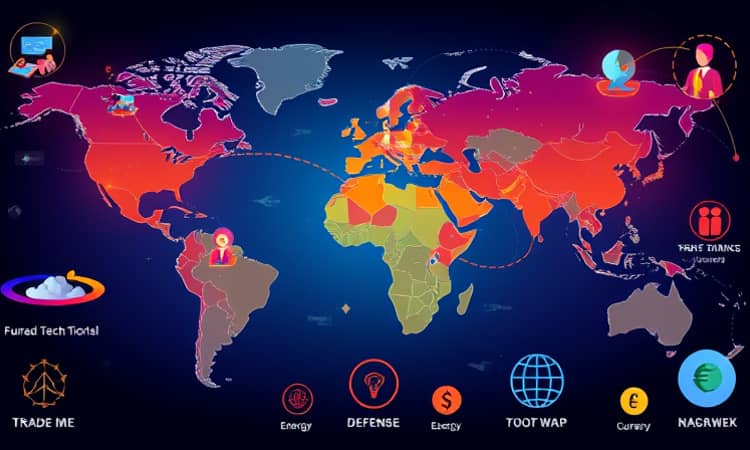
In an era defined by shifting alliances and strategic competition, understanding the nexus between diplomacy and capital flows is essential. Investors who grasp the contours of global politics can uncover hidden opportunities and shield portfolios from unforeseen shocks. This article explores how fine balance between tailwinds and headwinds in the world economy is shaped by diplomatic breakthroughs, territorial tensions, and policy changes.
The Triad of Global Tensions Shaping 2026
As 2026 unfolds, three powerful forces will dominate markets and diplomatic agendas. Their interplay will determine whether economies accelerate, stagnate, or contract, and will guide prudent investors toward resilient strategies.
Great-Power Rivalry and Global Financial Currents
The relationship between Washington and Beijing is entering an unsteady peace with clear guardrails. After a year of tit-for-tat tariffs, both capitals are prioritizing diplomatic visits—President Trump to China in spring and President Xi to the US around the G20. These trips aim to contain escalation and provide market confidence that trade tensions will not spiral out of control.
Meanwhile, competition in robotics, genomics, and AI has intensified. Chinese state capital competes with five or six huge US companies and other global players to lead in transformative technology. Supply-chain realignments and export controls are prompting firms to rethink sourcing, while investors consider prime beneficiaries of government incentives.
Regional Hotspots: Opportunity Amid Uncertainty
The fragmentation of the global order has accentuated regional disparities. Savvy investors can capitalize on dynamic pockets of growth, even amid headline-grabbing conflicts.
- Middle East: Saudi Arabia and the UAE are directing vast spending toward energy transition and digital infrastructure, creating emerging energy and technology hubs.
- Europe: Russia’s threat has galvanized sustained defense budgets, producing meaningful procurement cycles for military and cybersecurity firms.
- Asia: Japan’s bond-market pressures contrast with India’s reform-driven expansion, offering divergent plays in sovereign debt and equity.
Despite volatility, each region offers targeted investments in core sectors—energy, defense, and technology—that benefit from enduring policy support and geopolitical necessity.
Navigating Policy Uncertainty and Domestic Politics
The United States remains a primary source of flux. A midterm election in November 2026, coupled with aggressive immigration and trade proposals, ensures that policy direction can pivot quickly. Across the Western Hemisphere, from Mexico’s USMCA review to interventionist rhetoric in Venezuela, shifting policy direction under scrutiny will reverberate through currencies, sovereign bonds, and cross-border capital flows.
Technology and National Security Convergence
AI, once viewed mainly as an efficiency tool, is now at the heart of national defense strategies. Governments are classifying advanced algorithms as critical infrastructure, unleashing robust capital expenditures in strategic technology sectors. Investors must assess both growth potential and regulatory risk. A sudden correction in AI-linked assets could tighten financial conditions, underscoring the need for thorough stress testing.
Structuring Portfolios for a Fractured World
The coming decade will not mirror the globalization era. Instead, we face deep structural geopolitical shifts that demand agility. Passive strategies may underweight crucial risks, while active approaches can tilt toward evolving themes—defense, clean energy, and digital sovereignty.
- Scenario analysis for geopolitical shocks
- Diversification across currencies and regions
- Focus on strategic sectors like defense and clean energy
By incorporating a national security lens on technology and embracing active management and scenario planning, investors can navigate the crossroads of politics and markets with greater resilience. Above all, a forward-looking mindset unlocks opportunities that lie hidden beneath geopolitical headlines.
As the world enters a phase of structurally higher inflation and lower growth, understanding diplomatic dynamics is no longer optional—it is essential. Embrace the complexity, lean into research, and let the interplay of politics and policy guide you toward portfolios built for both protection and outperformance in uncertain times.