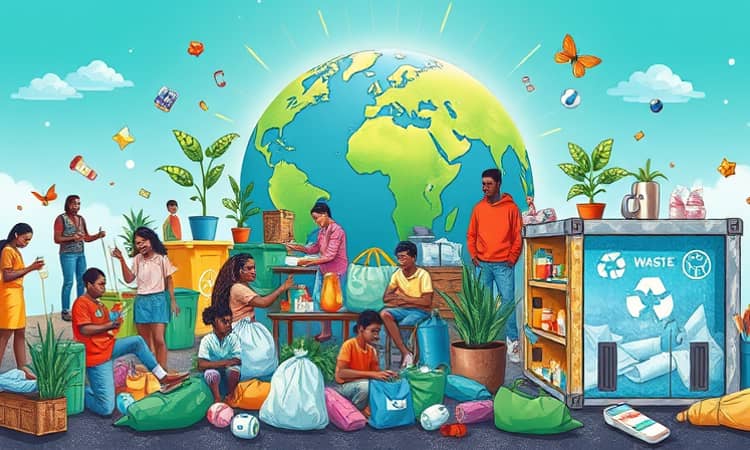
Across continents, communities and corporations are turning the tide on waste, pioneering an economic revolution that redefines value. The circular economy transcends mere recycling—it orchestrates a harmonious flow of materials, energy, and ideas that can unlock untapped economic potential while preserving planetary health. As global leaders double down on sustainable strategies, the path from trash to treasure is clearer than ever.
From burgeoning digital platforms to grassroots social enterprises, the movement is both vast and intimate. In this article, we explore the market dynamics, innovations, policies, case studies, and compelling benefits that are propelling the global circular economy market toward a brighter, more equitable tomorrow.
Market Dynamics and Growth Trajectory
The global circular economy market is experiencing unprecedented expansion. Analysts project it to reach USD 517.79 billion in 2025, growing to USD 578.09 billion in 2026 at a CAGR of approximately 11.6%, and further surging to USD 798.3 billion by 2029. Parallel to this, the digital circular economy segment—powered by IoT and AI for resource optimization—is set to expand from USD 3.72 billion in 2025 to USD 9.99 billion in 2029 (CAGR 28.0%).
Specialized markets are also blossoming. The plastic recycling industry is forecasted to grow from USD 48.59 billion in 2025 to USD 67.58 billion by 2029 (CAGR 8.6%). Meanwhile, bio-based materials, such as corn- and seaweed-derived bioplastics, are projected to leap from USD 47.97 billion to USD 106.69 billion over the same period, at a remarkable CAGR of 22.1%.
Innovations Shaping Tomorrow
At the heart of this transformation lie trailblazing technologies and design philosophies. From advanced chemical recycling to regenerative production models, innovators are sculpting a new industrial landscape.
- Internet of Waste & AI Integration: Real-time tracking systems optimize collection routes, reduce overflow, and forecast material availability.
- Advanced Plastic Recycling Methods: Enzymatic and pyrolysis techniques break down polymers for near-pristine feedstocks, tackling the 460 million metric tons of annual plastic production.
- Bio-based Materials Revolution: Companies like Shellworks harness seaweed, while startups convert agricultural residues into compostable packaging.
- Circular Design Principles: Digital product passports, modular electronics, and upcycling platforms extend product lifecycles and empower consumers to return items for refurbishment.
These innovations do more than divert waste—they create a continuous loop of value, mirroring natural ecosystems where waste from one process becomes input for another.
Regional Policies Driving Change
Governments worldwide are codifying circularity into law, setting the stage for systemic transformation. Below is a snapshot of key regional initiatives:
These policies not only regulate waste—they create incentives for circular innovation, attract investment, and ensure accountability across supply chains.
Waste-to-Wealth Case Studies
From small cooperatives to multinational ventures, real-world examples showcase the human and economic impact of circular strategies.
In India, women-led self-help groups in Vadodara channel 4,800 kg of wet waste into premium compost, generating sustainable income streams. Elsewhere, entrepreneurs transform 5,000 kg of single-use plastic into durable fabric, unlocking artisan livelihoods that yield up to Rs. 20 lakhs annually.
In Sri Lanka, grassroots initiatives like Yaal Fibre process 240 kg of plastic waste monthly, creating 14 steady jobs. Paalam partners with universities to upcycle textile offcuts, demonstrating how bottom-up social enterprises can reshape economies and empower communities.
The Broader Promise: Economic, Environmental, and Social Benefits
- Economic Gains: Valorizing waste streams reduces reliance on virgin materials; recycled minerals can emit 80% fewer greenhouse gases than traditional mining.
- Environmental Preservation: Circular systems cut emissions, curb pollution, and support regenerative models that replenish soil and conserve water.
- Social Empowerment: Job creation in recycling, refurbishment, and design sectors enables financial independence for marginalized groups.
As the World Economic Forum spotlights circularity as a pillar of clean energy transitions, and extended producer responsibility schemes evolve to focus on product performance, the momentum for systemic change grows stronger.
Embedding circularity at every stage—from raw material extraction to end-of-life processing—can close global waste loops, foster resilient supply chains, and build prosperous, equitable societies.
By viewing waste not as a burden but as a resource, we can co-create a future where innovation, sustainability, and human well-being are inextricably linked. The journey from waste to wealth is underway—will you join the movement?