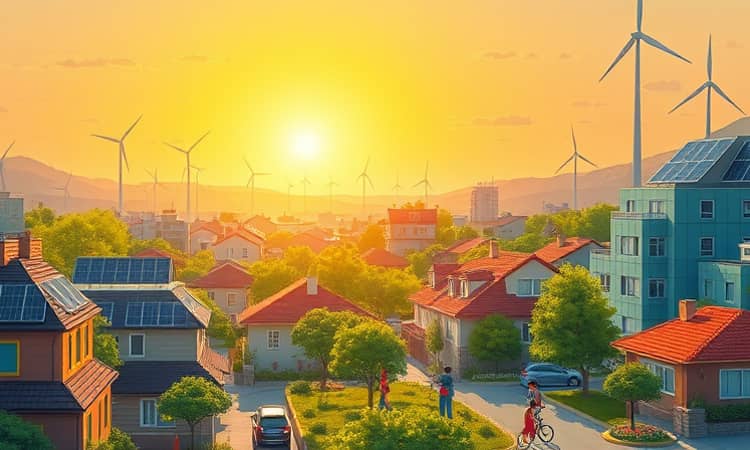
The world is at a pivotal moment, where the acceleration of global warming demands urgent action.
Recent projections indicate that 2026 will likely be among the four warmest years on record, pushing temperatures dangerously close to 1.5°C above pre-industrial levels.
This reality is not just a statistic; it is a call to innovate and adapt, turning climate challenges into avenues for progress and prosperity.
By understanding the risks and seizing the opportunities, we can build a more sustainable and equitable future.
The Warming World: Where We Stand
Climate data reveals a stark trend of rising temperatures.
The UK Met Office projects that 2026 could see warming of about 1.46°C above the 1850–1900 average.
This follows a pattern where the last three years have all likely exceeded 1.4°C above pre-industrial levels.
Independent analyses, such as from James Hansen’s group, suggest further increases, with potential records around +1.7°C by 2027 if El Niño develops.
The World Meteorological Organization reports a 70% chance that the five-year average for 2025–2029 will surpass 1.5°C.
This underscores the urgency of action, as we face:
- Multiple record-breaking temperatures in recent years.
- An acceleration partly due to changes in aerosol forcing.
- Increasing probabilities of breaching critical thresholds.
The Stakes: Economic and Social Risks
Ignoring climate change carries severe economic consequences.
A World Bank synthesis warns that climate impacts could cause 43 million job losses by 2050 across 49 countries, with potential losses rising to 260 million jobs in low- and middle-income nations.
Sectors like agriculture, tourism, and construction are particularly vulnerable to heat stress and extreme weather.
The Climate Risk Index highlights compounding development risks for countries hit by storms, floods, and heatwaves.
For advanced economies, stepping back means higher costs in energy, food, and insurance, as renewables become cheaper and disasters disrupt infrastructure.
Key risks include:
- Direct physical impacts on productivity and livelihoods.
- Rising fiscal burdens from repeated extreme events.
- Missed opportunities in the growing green economy.
The Transition: Embracing the Climate Economy
Despite challenges, the transition to a climate-resilient economy is gaining momentum.
Ten years after the Paris Agreement, global per capita emissions are falling, and renewable energy is expanding massively.
More than 100 countries have adopted net-zero targets, though progress remains insufficient to meet goals.
The green economy has exceeded $5 trillion in annual value and is expected to reach about $7 trillion by 2030.
This growth is driven by:
- Corporate net-zero targets covering supply chains.
- Cost-competitive clean energy technologies.
- Investment in mitigation and adaptation solutions.
Decarbonization technologies, such as solar and wind, are often cheaper than fossil fuels, especially when considering volatility and externalities.
Sustainable Solutions Across Sectors
Practical solutions are emerging across key sectors, offering pathways to reduce emissions and build resilience.
In energy and power systems, renewables are reaching new highs, with installations expected to increase in 2026.
Energy storage and batteries are growing strongly, supported by advancements in chemistries and AI optimization.
Europe is leading with fiscal support, such as Germany’s over €100 billion decarbonization program.
For transport, electric vehicle adoption continues to rise globally, making electrification a structural trend.
In industry and buildings, efficiency measures and low-carbon heating provide short paybacks and resilience.
Table below summarizes key solution areas:
These solutions are not just technical; they represent a shift towards sustainable practices that can be adopted globally.
Empowering Jobs and Finance
The climate transition is creating new economic opportunities, but it requires focused investment and skills development.
Jobs in renewable energy, green construction, and adaptation services are on the rise, offsetting losses in vulnerable sectors.
Financing is crucial, with declining interest rates improving the economics of long-duration infrastructure projects.
To capitalize on this, we must:
- Invest in education and training for green skills.
- Mobilize public and private capital for sustainable projects.
- Support small businesses and communities in the transition.
This empowers individuals and economies to thrive in a changing world.
Policy and Equity: A Global Imperative
Effective climate action depends on inclusive policies and geopolitical cooperation.
Equity is essential, as low-income countries often bear the brunt of impacts while having fewer resources to adapt.
International agreements, like the Paris Accord, provide a framework, but implementation must be accelerated.
Key policy actions include:
- Subsidies for clean energy and efficiency upgrades.
- Regulations to phase out fossil fuels gradually.
- Support for climate justice and community-led initiatives.
By fostering collaboration, we can ensure that the benefits of the climate economy are shared widely.
Conclusion: Seizing the Opportunity
Capitalizing on climate is not just about avoiding disaster; it is about building a better future.
By embracing sustainable solutions, we can drive innovation, create jobs, and enhance resilience.
The time to act is now, with every step towards decarbonization contributing to a healthier planet.
Let us move forward with hope and determination, turning the warming world into a catalyst for positive change.