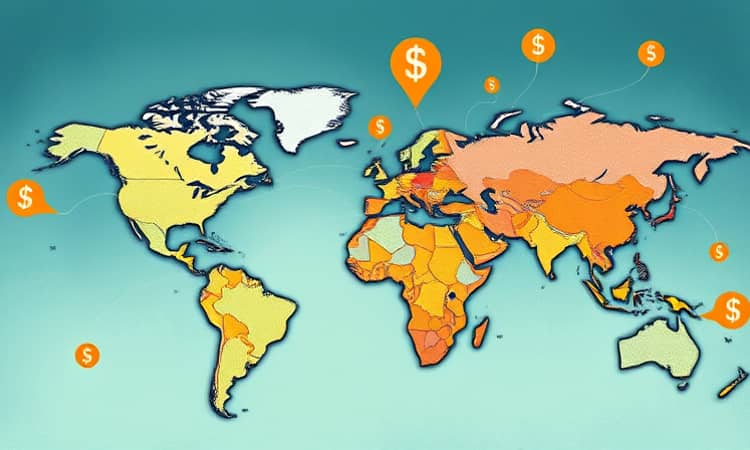
Every day, vast sums of money cross borders, shaping economies and influencing lives worldwide.
These cross-border movements of financial capital are recorded in balance of payments, driving investment and growth.
By tracing their path, we can uncover opportunities and risks in a dynamic global market.
Understanding the Fundamentals of Capital Flows
Capital flows refer to the transfer of assets between countries for investment or trade purposes.
They are categorized into key types that reflect different economic intentions and impacts.
- Foreign Direct Investment (FDI): Long-term investments with control, such as building factories.
- Portfolio flows: Short-term trades in stocks and bonds without management influence.
- Other investment: Includes bank loans and deposits that facilitate daily operations.
- Official flows: Government or multilateral lending for development or stability.
Distinguishing between gross and net flows helps analysts gauge true economic health.
For instance, reinvested earnings can skew FDI data, masking actual cash movements.
This taxonomy is crucial for policymakers and investors aiming to navigate global financial systems effectively.
A Historical Perspective on Global Capital Movements
The evolution of capital flows is marked by cycles of boom and bust that teach valuable lessons.
In the 1970s and 1980s, petrodollar recycling fueled lending to Latin America.
This led to the 1980s debt crisis, where sudden stops triggered widespread defaults.
The 1990s saw liberalization in emerging markets, but crises like the Asian Financial Crisis emerged.
These events highlighted vulnerabilities to short-term foreign currency debt.
- 1994–95: Mexico's Tequila Crisis shocked markets with rapid capital reversals.
- 1997–98: Asian Financial Crisis demonstrated the dangers of speculative flows.
- 2008–09: Global Financial Crisis caused violent outflows, followed by quantitative easing rebounds.
More recently, the 2013 taper tantrum showed how US monetary policy affects global liquidity.
China's 2014–15 devaluation episode and the COVID-19 shock further illustrate surges and sudden stops in capital.
This history underscores the need for resilient financial frameworks.
Current Trends and Forecasts to 2026
Looking ahead, global capital flows are influenced by slowing growth and shifting policies.
Projections indicate world output may slow to 2.7% in 2026, below pre-pandemic averages.
This slowdown is driven by weak demand in Europe and debt constraints in developing economies.
Financial conditions have eased, but borrowing costs remain elevated, affecting investment decisions.
- Trade and investment face headwinds from protectionism and climate shocks.
- AI-related sectors see high valuations, drawing portfolio inflows despite risks.
- Global capital flow stability is anchored by internal rotations across major economies.
The Institute of International Finance forecasts global growth around 3.1% in 2026.
This suggests a moderate but stable environment for cross-border money movements.
This table highlights how regional disparities shape capital allocation strategies.
Regional Narratives: Money on the Move
North America, led by the US, remains a magnet for global savings due to its deep markets.
With growth projected at 1.9% in 2026, AI-driven investment continues to attract capital.
Europe faces slower growth, around 1.4%, impacting FDI and bank flows negatively.
Structural reforms and green transitions could revitalize investment channels in the region.
China's story is one of divergence, with flows weakening post-COVID due to geopolitical tensions.
Brookings data shows a sharp decoupling from other emerging markets since 2020.
- FDI to China has declined as a share of GDP over years.
- Portfolio flows dipped with escalating US-China trade restrictions.
- Other investment fell after Russia's invasion of Ukraine.
This trend fuels the China plus one strategy, where investors diversify into other EMs.
In broader emerging markets, flows are at historical highs, supported by commodity cycles.
Low-income countries struggle with high debt, but official flows offer some relief.
Drivers Shaping Capital Flows
Multiple factors influence how money moves across continents, from interest rates to technology.
Central bank policies, especially in the US, set the tone for global risk appetite.
Growth differentials between regions drive investment towards higher-yielding opportunities.
Geopolitical tensions, like trade wars, can redirect capital swiftly to safer havens.
- Monetary policy: Rate cuts spur inflows, while hikes trigger outflows.
- Economic growth: Stronger economies attract more FDI and portfolio investment.
- Regulation: Tighter rules may dampen flows, but enhance stability.
- Technology: Innovations like fintech facilitate faster cross-border transactions.
- Climate change: Green investments are becoming a significant flow driver.
Understanding these drivers helps stakeholders anticipate shifts and adapt strategies.
Policy Debates and Future Risks
As capital flows evolve, policymakers grapple with balancing openness and stability.
Debates center on whether to impose capital controls or promote liberalization.
Risks include sudden stops, currency volatility, and asset bubbles in overheated markets.
Climate-related flows are rising, but funding gaps persist for sustainable development.
- Capital controls: Used to manage volatility, but may deter long-term investment.
- Macroprudential measures: Aim to build buffers against financial crises.
- International cooperation: Essential for addressing cross-border spillovers.
Looking to 2026, fostering inclusive growth requires smart policies that harness capital for good.
By tracing money's movement, we can build a more resilient and equitable global economy.