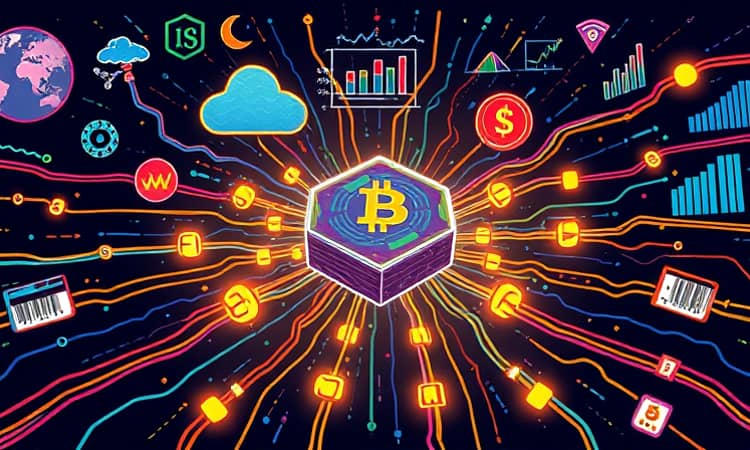
In the world of decentralized ledgers, blockchains stand as bastions of trust, security, and immutability.
Yet they are inherently isolated, unable to reach beyond their deterministic confines to gather information about events and metrics unfolding in the real world. This barrier has long limited the potential of smart contracts, preventing them from responding dynamically to external data such as market prices, weather readings, or shipment statuses.
The Limitations of Native Blockchains
At their core, blockchains operate on predefined rules and consensus algorithms. They verify transactions, maintain state, and execute code in a closed environment.
While this design guarantees unparalleled security through decentralized validation, it also creates a vacuum. Without an internal mechanism to fetch external data, smart contracts cannot be triggered by anything they cannot see on the ledger itself.
Imagine a crop insurance policy that pays out when rainfall falls below a critical threshold. If the smart contract cannot verify precipitation data from a weather station, the agreement remains dormant, regardless of losses suffered by the farmer.
How Oracles Bridge the Divide
Enter blockchain oracles: third-party services that ensure reliability and act as interpreters between blockchains and the outside world. Oracles handle four key stages:
- Data acquisition: fetching raw information from APIs, IoT sensors, or databases
- Data processing: cleaning, validating, and aggregating for accuracy
- Data transmission: delivering cryptographically signed messages on-chain
- Smart contract invocation: triggering predefined functions upon receipt
By encapsulating complexity, oracles offer trusted off-chain data sources that smart contracts can consume with confidence, enabling a new generation of responsive, condition-based applications.
Types of Oracles
Not all oracles are created equal. Developers choose from several categories depending on trust, cost, and performance requirements.
Some implementations rely on centralized points of contact, while advanced networks employ decentralized oracle networks for consensus, minimizing trust assumptions and single points of failure.
Overcoming the Oracle Problem
The so-called “oracle problem” arises when a single data provider can manipulate outcomes. To mitigate this risk, developers implement data aggregation from multiple sources, reputation systems for node operators, and cryptographic proofs and attestations. Platforms like Chainlink apply these principles, using oracle networks to ensure that no one actor controls the information flow. This approach effectively eliminate single points of failure and fosters a more resilient data delivery model.
Real-World Applications Across Industries
Today, oracles power a myriad of decentralized applications, transforming industries one event at a time. They:
- Provide live price feeds for lending, borrowing, and automated liquidations in DeFi
- Enable parametric insurance claims based on weather or flight data
- Offer real-time tracking and provenance in supply chain management
- Support dynamic traffic management and pollution monitoring in smart cities
- Ensure provably fair randomness for gaming and entertainment platforms
- Facilitate cross-chain asset management and middleware integration for enterprises
These use cases highlight how oracles unlock new realms of automated trust, replacing manual processes with transparent, unstoppable code execution.
Case Study: Chainlink's Impact
Chainlink stands at the forefront of oracle innovation. By aggregating data from multiple independent node operators, it enables developers to build seamless integration of off-chain inputs without sacrificing decentralization. Notable partnerships with AccuWeather for verified weather data, FedEx for secure package tracking, and Tiingo for financial market feeds illustrate the network’s versatility. With its evolving architecture supporting off-chain compute, verifiable randomness, and cross-chain interoperability, Chainlink exemplifies how oracles can deliver bridges between blockchains and real-world data at scale.
Looking Ahead: The Future of a Verifiable Web
As blockchain adoption accelerates, oracles will underpin the next wave of automation, bringing distributed ledgers into seamless dialogue with the physical world.
Future advancements may include:
- Advanced privacy-preserving computations off-chain
- Machine learning integration for predictive oracles
- Expanded sensor networks feeding city-scale dApps
By extending smart contracts beyond token transfers to real-world logic and computation, oracles will catalyze innovations that mirror the transformative power of the Internet, but for value exchange.
In this emerging paradigm, developers and organizations can build systems that react instantly to real events, automate complex workflows, and offer trustless guarantees on verifiable data feeds. The promise of blockchain oracles lies not only in technical elegance but also in their capacity to foster an ecosystem of unstoppable, self-executing agreements that redefine how we transact, insure, and interact with digital and physical environments.
Embrace the oracle revolution, and witness how connecting real-world data to smart contracts can unlock a new era of innovation, transparency, and trust.