Over the last decade, the global economic landscape has evolved far beyond a simple G7 versus BRICS dichotomy. While BRICS remains a heavyweight, a constellation of other emerging and mid-sized powerhouses is reshaping growth, trade and innovation. This article maps that broader terrain, offering insights and practical frameworks for policymakers, investors and business leaders.
Framing a Multipolar Economy
Once framed as a contest between G7 and BRICS, today’s world economy is better described as a fragmented multipolar system. BRICS+, an expanded grouping of core members and partners, now accounts for roughly 35–40% of global GDP in PPP terms, surpassing the G7 share. It also represents close to 45–46% of the world’s population. Projections for 2025 suggest BRICS members will contribute an estimated 41% of global GDP (PPP) versus just ~28% for the G7.
Growth differentials further underscore this shift. IMF forecasts anticipate BRICS expanding at around 4.0% in 2024 and 3.4% in 2025, compared to G7 rates of 1.7% and 1.2%, respectively. From 2010 to 2023, BRICS accounted for 42% of global GDP growth and is expected to deliver about 58% of world growth through 2029. In contrast, the G7’s share of that future growth sits near 25%.
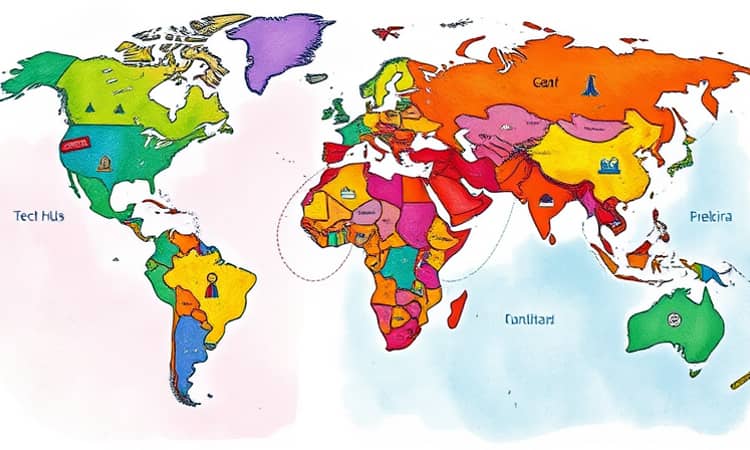
This data sets up our key narrative: BRICS is only one node in a multi-node Global South arrayed across supply chains, climate dynamics, demographic shifts and technology revolutions. Understanding these other nodes is critical for any stakeholder in today’s economy.
Inside BRICS: A Critical Benchmark
Before exploring new powerhouses, it’s important to recognize why BRICS still matters as a benchmark. The core five—Brazil, Russia, India, China and South Africa—have expanded to include Egypt, Ethiopia, Iran, the UAE and Indonesia, with additional partners like Saudi Arabia, Nigeria and Vietnam often cited in broader analyses.
Sectoral strengths drive this grouping’s heft. BRICS members supply vast quantities of energy and strategic minerals, control significant shares of global food and metals markets, and are rapidly scaling clean energy investments. Solar power generation across the original five rose 39% year-on-year in early 2025, outpacing many advanced economies.
Geopolitically, BRICS functions as a counterpoint to the hegemony of the United States. Intra-BRICS trade has surpassed US$1 trillion, with nearly half conducted in local currencies, and the New Development Bank is financing infrastructure, renewable energy and sustainable projects to reduce dependence on Western-dominated institutions.
This table underscores why BRICS remains a critical reference, but the true story lies in those economies rising alongside or around this bloc.
Next-wave Emerging Economies
A new cohort of emerging markets is posting above-trend growth, sizeable markets and strategic sectors. Key examples include:
- Vietnam: One of Asia’s fastest-growing economies, integrated into electronics, garments and electric vehicle supply chains as a “China+1” manufacturing hub.
- Mexico: A major beneficiary of US nearshoring, with robust auto and electronics output and demographic advantages relative to many rich countries.
- Bangladesh: A textile and garment powerhouse moving into pharmaceuticals and light manufacturing, sustaining annual growth near 6–7%.
- Philippines: Leveraging a young population, diaspora remittances and a booming business process outsourcing sector to rival some BRICS growth rates.
African stars such as Kenya, Ghana and Côte d’Ivoire are also gaining attention for digital finance innovations like mobile money, and projected labor-force growth that will drive consumer markets through mid-century.
Resource-rich Swing States
Countries with abundant natural resources and strategic geopolitics can punch above their weight. Leading names include:
- Saudi Arabia: Central to OPEC+ and backed by its Vision 2030 diversification plan into tourism, green hydrogen and technology.
- Nigeria: Africa’s most populous country, rich in oil and gas, with a consumer market poised to expand if structural reforms stick.
- Kazakhstan: A Belt and Road linchpin with oil, gas and uranium reserves, crucial to Eurasian trade corridors.
- Chile and Bolivia: Dominant in copper and lithium, essential to the electric vehicle and renewable energy value chains.
Tech and Finance-centric Hubs
Some smaller states wield disproportionate influence through capital and innovation:
- Singapore: A global shipping, financial and semiconductor hub, shaping AI governance and trade standards.
- United Arab Emirates: Now a BRICS member, the UAE transformed from an oil exporter into a logistics, tourism and finance epicenter.
- Israel: A leader in startups, cybersecurity, agritech and defense technologies that feeds innovation across borders.
These hubs act as connectors, linking G7 markets, BRICS economies and the broader Global South.
Regional Anchors and Middle Powers
Finally, several “middle powers” play outsized roles within their regions, balancing diplomatic ties and economic ambitions:
- Turkey: A NATO member and G20 economy bridging Europe, the Middle East and Central Asia, vital in energy transit and grain exports.
- Indonesia: Southeast Asia’s largest economy, sitting on vast nickel and coal reserves and rapidly expanding into electric vehicle batteries.
- Egypt: Control of the Suez Canal and investments in renewables make it a strategic gateway between Europe and Africa.
Implications for Stakeholders and Businesses
Recognizing this wider network of powerhouses is not just an academic exercise—it informs strategy. Companies should:
- Map supply chains across multiple nodes to mitigate concentration risk.
- Monitor policy landscapes in resource-rich swing states for investment opportunities.
- Leverage tech hubs for partnerships in AI, fintech and clean energy solutions.
Policymakers and investors, meanwhile, can foster alliances that reflect this polycentric reality. By seeking balanced engagement across diverse regions, they position themselves to ride the next wave of global growth.
The era of bipolar economic competition is over. A richly interconnected, multipolar world has emerged. Understanding—and participating in—that broader cast of rising powerhouses will define success in the decades ahead.